


Highlights
- A pilot study evaluated 36 professional male athletes with acute soft tissue injuries.
- Adding hydrogen to standard treatment was associated with a faster return toward normal joint range of motion.
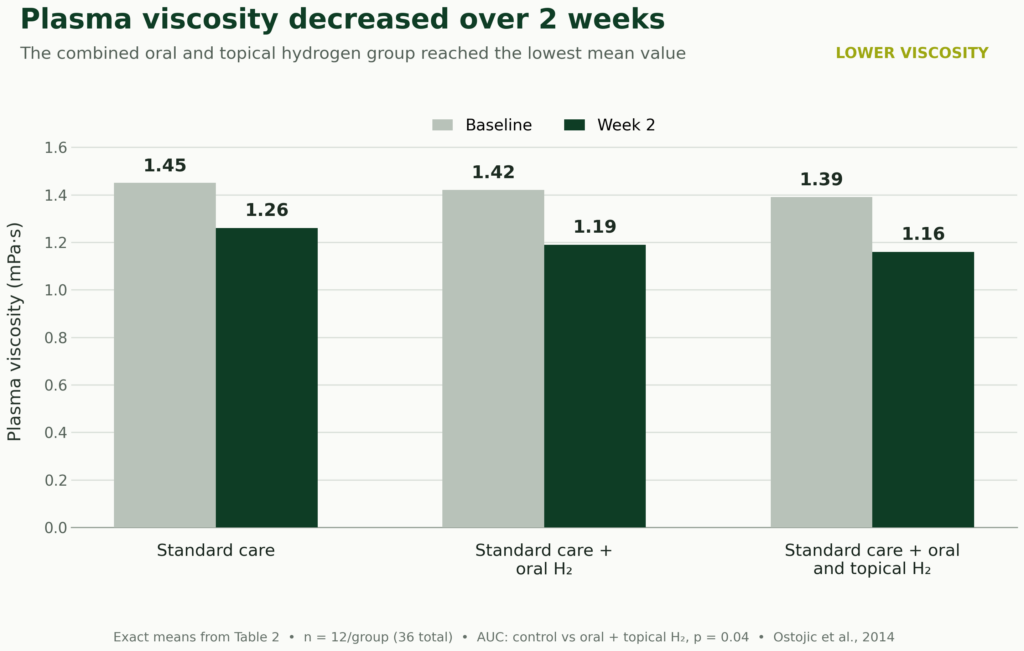
- The combination of oral and topical hydrogen also produced a greater reduction in plasma viscosity compared with standard treatment alone.
- The findings suggest that molecular hydrogen may have potential as an adjunctive strategy during recovery from soft tissue injury.
Study Design
Ostojic et al. investigated whether molecular hydrogen could support recovery following acute sports-related soft tissue injuries.
The study included 36 professional athletes, evaluated within 24 hours after an injury. The most common injuries included ligament sprains, muscle strains, and contusions.
Participants were randomly assigned to one of three groups:
- Standard conservative treatment
- Standard treatment plus oral hydrogen
- Standard treatment plus oral and topical hydrogen
The oral hydrogen group received hydrogen-rich tablets throughout the 2-week study, while the combined group also used topical hydrogen-rich packs applied to the injured area several times per day.
Researchers assessed the athletes at baseline, after 7 days, and after 14 days, monitoring inflammation-related markers, pain, swelling, and joint range of motion.
What Did They Find?
Joint Mobility Recovered Faster
One of the clearest findings involved range of motion.
Athletes receiving both oral and topical hydrogen showed a faster return toward normal joint flexion and extension compared with the group receiving standard treatment alone. The differences between groups were statistically significant.
This is particularly relevant because restoring mobility is one of the primary goals during recovery from musculoskeletal injury.
The authors concluded that hydrogen administration enhanced the recovery of joint flexibility when added to conventional care.
Hydrogen Was Associated With Changes in Plasma Viscosity
The combined oral and topical hydrogen intervention also produced a significantly greater reduction in plasma viscosity compared with standard treatment.
Plasma viscosity is influenced by inflammatory and circulatory factors and is often monitored as part of the physiological response to injury and recovery.
The authors considered this finding relevant because changes in plasma viscosity may reflect part of the recovery process following soft tissue injury.
Why Could Molecular Hydrogen Be Relevant?
Soft tissue injuries can trigger local oxidative stress and inflammation.
The study discusses molecular hydrogen as a molecule capable of rapidly diffusing into tissues and interacting with reactive oxygen species, particularly highly reactive molecules such as the hydroxyl radical.
In addition to its antioxidant-related actions, the authors note that hydrogen may also influence cell signaling and gene expression, suggesting that its biological effects may extend beyond direct interaction with reactive molecules.
This may help explain why molecular hydrogen is being investigated as a supportive strategy in conditions involving oxidative and inflammatory stress.
Why It Matters
Recovery from soft tissue injury involves more than simply reducing discomfort. Restoring normal movement and supporting the underlying tissue environment are key parts of the recovery process.
In this pilot study, adding molecular hydrogen to standard conservative care was associated with better recovery of joint range of motion and a greater reduction in plasma viscosity.
The authors therefore suggest that molecular hydrogen may have value as an adjunct to conventional recovery strategies, rather than as a replacement for them.
For wellness and recovery technologies, these findings are especially interesting because they highlight the potential role of molecular hydrogen in supporting functional recovery, oxidative balance, and the physiological response to tissue stress.
Reference: Ostojic SM, Vukomanovic B, Calleja-Gonzalez J, Hoffman JR. Effectiveness of Oral and Topical Hydrogen for Sports-Related Soft Tissue Injuries. Postgraduate Medicine. 2014;126(5). doi:10.3810/pgm.2014.09.2813.