


Highlights
- Combining vibroacoustic therapy with Baduanjin exercise improved cardiac function after 12 weeks of rehabilitation.
- Participants experienced greater improvements in heart rate variability (HRV), an important marker of autonomic nervous system regulation.
- The combined program also led to better mood and higher quality of life compared with exercise alone.
- These findings support vibroacoustic therapy as a valuable complementary strategy in comprehensive cardiac rehabilitation.
Study Design
Researchers retrospectively evaluated 200 patients with coronary heart disease (CHD) who had undergone percutaneous coronary intervention (PCI). After propensity score matching to balance baseline characteristics, 120 patients (60 per group) were included in the final analysis.
Participants completed a 12-week rehabilitation program consisting of:
- Baduanjin exercise only, or
- Vibroacoustic therapy combined with Baduanjin exercise.
The vibroacoustic therapy protocol consisted of 30-minute sessions using mechanical vibrations between 50–80 Hz, accompanied by music delivered through headphones. Patients received therapy daily during hospitalization and twice weekly after discharge, while all participants practiced Baduanjin exercise five times per week.
Researchers assessed:
- Cardiac function (LVEF, stroke volume, LVESD and LVEDD)
- Heart rate variability (SDNN and RMSSD)
- Psychological state (POMS-SF)
- Quality of life (SF-36)
- Clinical complications.
What Did They Find?
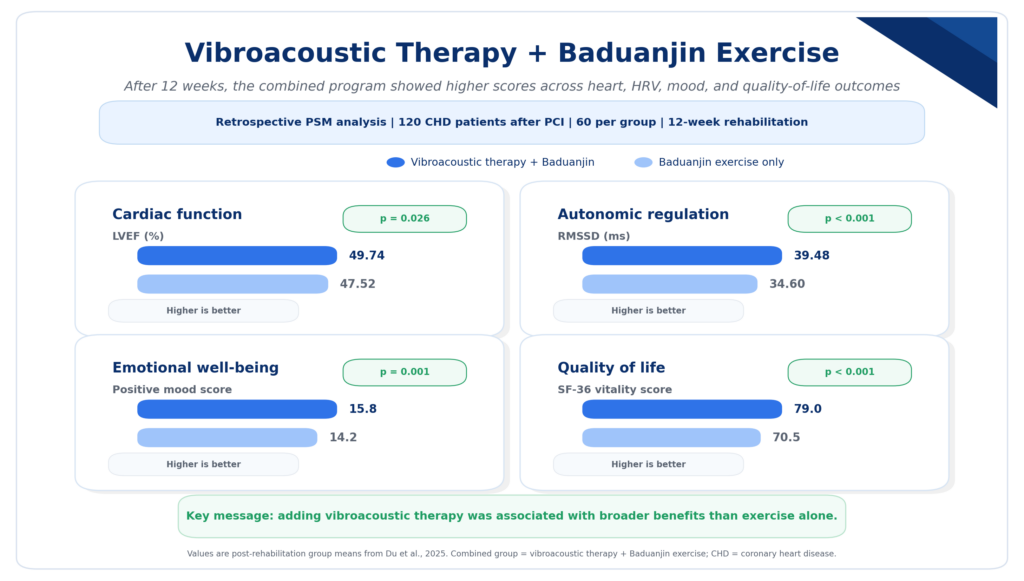
Compared with exercise alone, the combination of vibroacoustic therapy and Baduanjin produced significantly greater improvements across multiple clinical outcomes.
Better Cardiac Function
After 12 weeks, the combined therapy group demonstrated:
- Higher left ventricular ejection fraction (LVEF) (49.7% vs. 47.5%)
- Higher stroke volume
- Lower left ventricular end-systolic diameter (LVESD)
- Lower left ventricular end-diastolic diameter (LVEDD)
Together, these findings suggest improved cardiac pumping efficiency.
Improved Autonomic Nervous System Regulation
Patients receiving vibroacoustic therapy also showed significantly greater improvements in HRV:
- Higher SDNN
- Higher RMSSD
Both HRV markers are commonly associated with healthier autonomic regulation and increased parasympathetic activity.
Better Mood and Quality of Life
The combined therapy group reported:
- Lower negative mood scores
- Higher positive mood scores
- Significant improvements across all eight domains of the SF-36 quality-of-life questionnaire, including vitality, physical functioning, mental health, social functioning and general health perception.
Importantly, complication rates were similar between groups, suggesting that adding vibroacoustic therapy did not increase adverse events during rehabilitation.
Why It Matters
Recovery after coronary heart disease extends beyond restoring cardiac function. Many patients continue to experience reduced autonomic regulation, anxiety, depression and diminished quality of life long after medical treatment.
In this study, adding vibroacoustic therapy to a structured exercise program was associated with greater improvements in both physiological and psychological outcomes than exercise alone. The authors suggest these benefits may be related to the multisensory nature of vibroacoustic therapy, which combines sound with low-frequency mechanical vibration to support autonomic nervous system regulation, promote relaxation and complement conventional rehabilitation.
Reference: Du X, Miao B, Jia L. Effect of Vibroacoustic Therapy Combined with Baduanjin Exercise on the Cardiac Function and Psychological State of Patients with Coronary Heart Disease. Noise Health. 2025;27(127):468-475. doi:10.4103/nah.nah_193_24
Read the full article: Click here