


Highlights
- A pilot study evaluated a 20-minute vibroacoustic stimulation session in healthy adults.
- After the intervention, participants showed a breathier vocal quality, a speech pattern associated in the study with greater physiological relaxation.
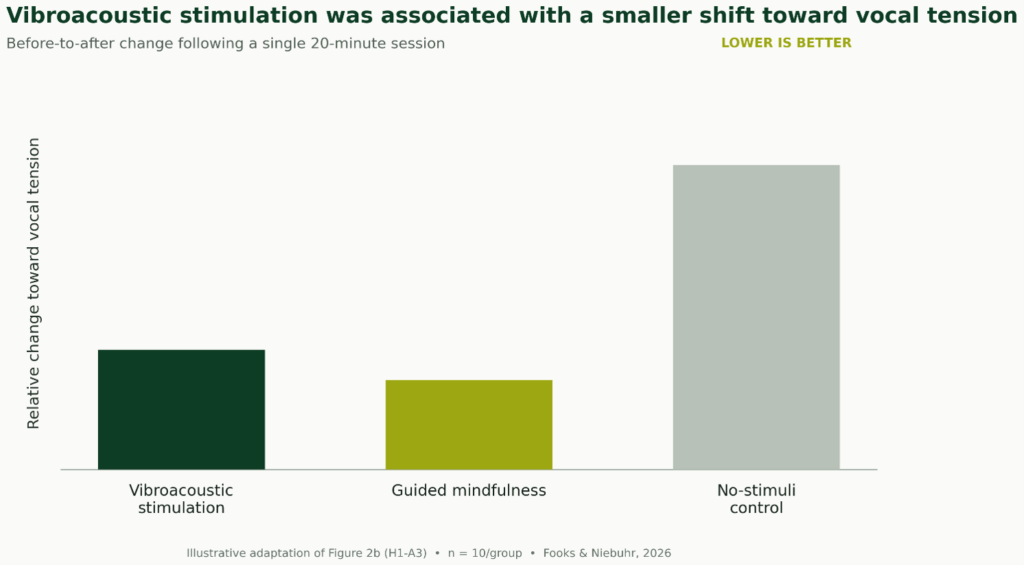
- The vibroacoustic group also avoided the increase in vocal tension and effort observed in the control group.
- The results suggest that vibroacoustic stimulation can produce measurable changes in stress-related physiological signals, even after a relatively short session.
Study Design
Fooks and Niebuhr (2026) investigated whether a short vibroacoustic session could produce measurable changes associated with relaxation and stress response.
The study included 30 adults between 27 and 50 years old, who were divided into three groups:
- Vibroacoustic stimulation
- Guided mindfulness meditation
- No-stimuli control
Each participant experienced one 20-minute intervention, and researchers compared speech recordings taken before and after the session.
Rather than relying only on questionnaires, the researchers used speech prosody—the rhythm, tone, loudness, and vocal quality of speech—as a biosignal.
Why speech?
Stress can alter breathing, muscle tension, vocal effort, pitch, and voice quality. Because of this, subtle changes in the voice can reflect shifts in physiological and psychological state.
The vibroacoustic intervention combined audible sound with synchronized tactile vibration, delivered through a body-supported vibroacoustic platform.
What Did They Find?
The Voice Became Less Tense After Vibroacoustic Stimulation
One of the clearest findings involved voice quality.
After the vibroacoustic session, participants showed a breathier vocal pattern, while the control group showed a more tense and constricted voice.
In speech analysis, a breathier voice generally reflects less vocal tension and effort.
The researchers found that both the vibroacoustic and mindfulness groups resisted the increase in vocal effort seen in the control group.
The Vibroacoustic Group Maintained a More Stable Vocal Pattern
The control group showed larger changes in several speech parameters after the 20-minute period, including pitch, loudness, and vocal effort.
By comparison, the vibroacoustic group showed smaller shifts from baseline, meaning their speech pattern remained more stable after the intervention.
The authors interpreted this as a potentially meaningful signal that vibroacoustic stimulation may help maintain a more balanced physiological state during the session.
A 20-Minute Session Was Enough to Produce Detectable Changes
The study was exploratory, but it showed that even a single 20-minute exposure could produce measurable differences in voice quality when compared with the control condition.
The most consistent finding was the shift toward a breathier, less tense vocal quality after vibroacoustic stimulation.
Importantly, the vibroacoustic and mindfulness groups showed similar patterns in several measures, suggesting that sound-plus-vibration stimulation may produce physiological effects comparable, in some respects, to a guided relaxation practice.
Why It Matters
Vibroacoustic stimulation combines sound and physical vibration, allowing the body to both hear and physically experience low-frequency acoustic energy.
This study is interesting because it shows that the effects of this kind of stimulation may be detectable not only through subjective feelings of relaxation, but also through objective changes in vocal characteristics associated with stress and physiological state.
The findings suggest that a short vibroacoustic session may help reduce signs of vocal tension and effort, supporting a more relaxed physiological response.
For wellness technologies that combine sound and vibration, this reinforces the idea that vibroacoustic stimulation can influence the body in a measurable way—through changes in tension, arousal, and stress-related physiological signals.
Reference: Fooks C, Niebuhr O. Assessing effects of vibroacoustic stimulation compared to a guided mindfulness meditation using the biosignal of human speech. Frontiers in Network Physiology. 2026;6:1677209. doi:10.3389/fnetp.2026.1677209.
Read the full article: Click here