


Highlights
- Transcranial vibroacoustic stimulation (tVAS) significantly improved global cognitive performance after 8 weeks.
- 40 Hz stimulation reduced depressive symptoms and enhanced electrophysiological markers of brain function.
- The intervention demonstrated a favorable safety profile, with only mild and transient adverse events.
- Findings support vibroacoustic therapy as a promising non-invasive approach to promote healthy brain aging.
Study Design
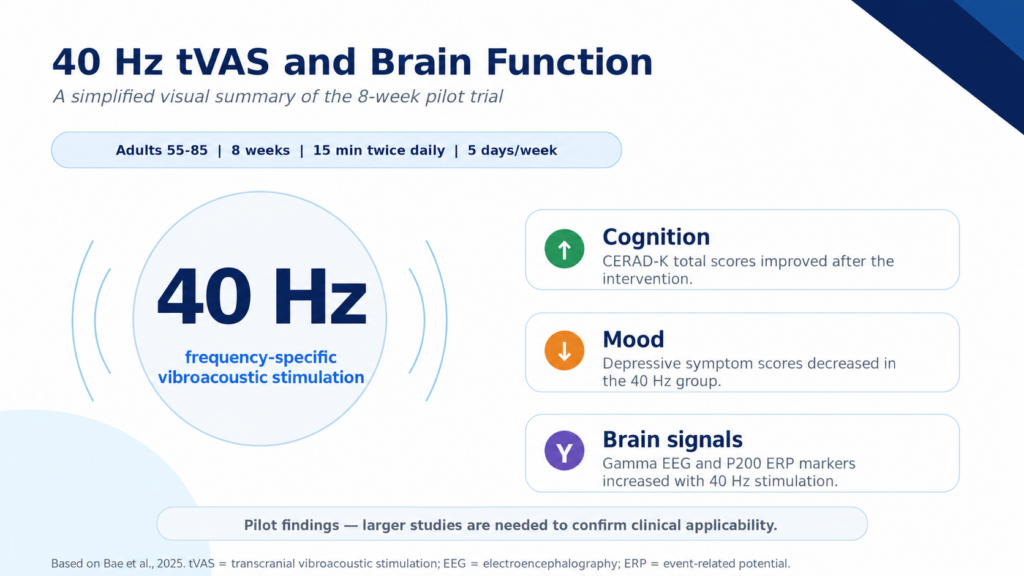
In this double-blind, randomized comparative trial, 30 healthy adults aged 55–85 years received transcranial vibroacoustic stimulation (tVAS) at either 20 Hz or 40 Hz for 8 weeks. Participants used the device twice daily for 15 minutes per session, five days per week.
Cognitive performance (CERAD-K), depressive symptoms (CES-D), electroencephalography (EEG), event-related potentials (ERP), and salivary cortisol levels were assessed before and after the intervention.
What Did They Find?
After eight weeks, both stimulation frequencies significantly improved overall cognitive performance based on CERAD-K total scores.
However, the 40 Hz group demonstrated additional benefits, including:
- Significant reductions in depressive symptoms;
- Increased EEG activity across multiple frequency bands, particularly gamma oscillations;
- Enhanced N100 and P200 ERP amplitudes, indicating improved sensory processing and neural efficiency;
- Evidence of stronger neural synchronization and enhanced brain plasticity.
The intervention was well tolerated, with only mild, transient adverse events and no serious safety concerns reported.
Why It Matters
Vibroacoustic therapy is emerging as a non-invasive approach capable of delivering precisely controlled mechanical and auditory stimulation to influence brain activity.
In this study, 40 Hz vibroacoustic stimulation was associated with improvements in cognitive performance, electrophysiological markers of neural processing, and depressive symptoms, suggesting that frequency-specific stimulation may help support neural plasticity and cognitive function.
While larger clinical trials are still needed, these findings add to the growing evidence supporting vibroacoustic therapy as a promising strategy for promoting brain health and supporting healthy cognitive aging.
Reference: Bae JH, Ha JY, Choung JJ, et al. Improvement of neuropsychological and cognitive functions in older adults through transcranial vibroacoustic stimulation: a double blind, randomized, comparative trial. Front Aging Neurosci. 2025;17:1526088. Published 2025 Aug 8. doi:10.3389/fnagi.2025.1526088
Read the full article: Click here