


Highlights
- Daily superficial heat therapy significantly reduced knee osteoarthritis symptoms.
- Treatment improved physical function and activities of daily living.
- MRI findings suggested positive effects on cartilage metabolism.
- The results support superficial heat therapy as a valuable complementary approach for joint health.
Study Design
Researchers conducted a randomized clinical trial involving 18 women aged 50–69 years with early-stage knee osteoarthritis. Participants were assigned to either local superficial heat therapy or exercise therapy for 12 weeks.
The heat intervention used moist heat-generating sheets that maintained the skin at approximately 40°C, applied over the knee for 6 hours per day. Before and after treatment, researchers evaluated clinical symptoms, functional mobility, and cartilage characteristics using MRI T2 mapping.
What Did They Find?
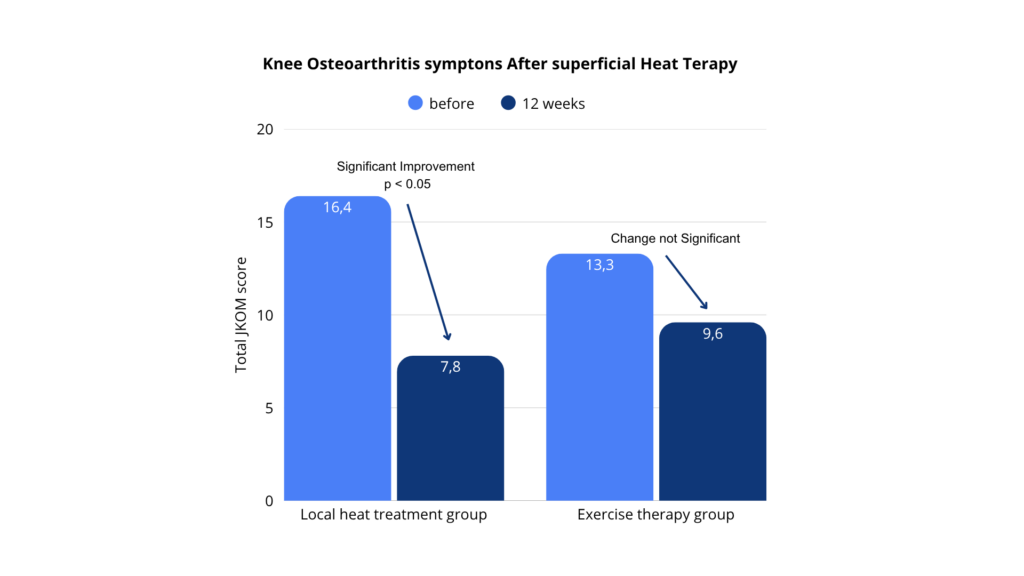
After 12 weeks, participants receiving superficial heat therapy experienced significant improvements in knee osteoarthritis symptoms.
Scores on the Japanese Knee Osteoarthritis Measure (JKOM) decreased significantly, indicating reduced pain and better performance in daily activities.
Although improvements in mobility assessed by the Timed Up and Go test did not reach statistical significance, 7 of the 9 participants in the heat group completed the test more quickly after treatment, suggesting a consistent trend toward improved function.
MRI also revealed a significant reduction in cartilage T2 values in the heat therapy group. According to the authors, this finding may reflect favorable changes in cartilage metabolism and structural integrity. No similar changes were observed in the exercise group.
Why It Matters
Superficial heat therapy is one of the most widely used conservative physical interventions for osteoarthritis. Heat increases local blood flow, improves tissue extensibility, raises pain thresholds, and supports muscle and periarticular metabolism.
Beyond these established physiological effects, this study suggests that prolonged superficial heat exposure may also positively influence the cartilage environment. The authors propose that increasing local tissue temperature may stimulate cartilage metabolism and support the production of key extracellular matrix components, including proteoglycans.
Although further research is needed to confirm these mechanisms, these findings support superficial heat therapy as a complementary strategy to reduce symptoms, improve function, and promote joint health in individuals with early-stage knee osteoarthritis.
Reference: Ochiai S, Watanabe A, Oda H, Ikeda H. Effectiveness of thermotherapy using a heat and steam generating sheet for cartilage in knee osteoarthritis. J Phys Ther Sci. 2014;26(2):281-284. doi:10.1589/jpts.26.281
Read the full article: Click here