


Highlights
- A single NanoVi® session was associated with improvements across all ten wellness measures evaluated.
- Significant increases were observed in freedom from stress, relaxation, mental clarity, reduced fatigue, and energy levels.
- Overall wellness scores increased by 19% following the session.
- These preliminary findings support further clinical investigation into NanoVi® and perceived wellness.
Study Design
In this preliminary report, eight participants (3 women and 5 men; mean age 53.7 years) completed a wellness questionnaire immediately before and after a single NanoVi® session. The questionnaire assessed ten wellness domains, including stress, anxiety, relaxation, mental clarity, fatigue, energy, physical comfort, and overall well-being using a 0–5 rating scale.
Pre- and post-session responses were analyzed using non-parametric statistical methods to identify changes following the intervention.
What Did They Find?
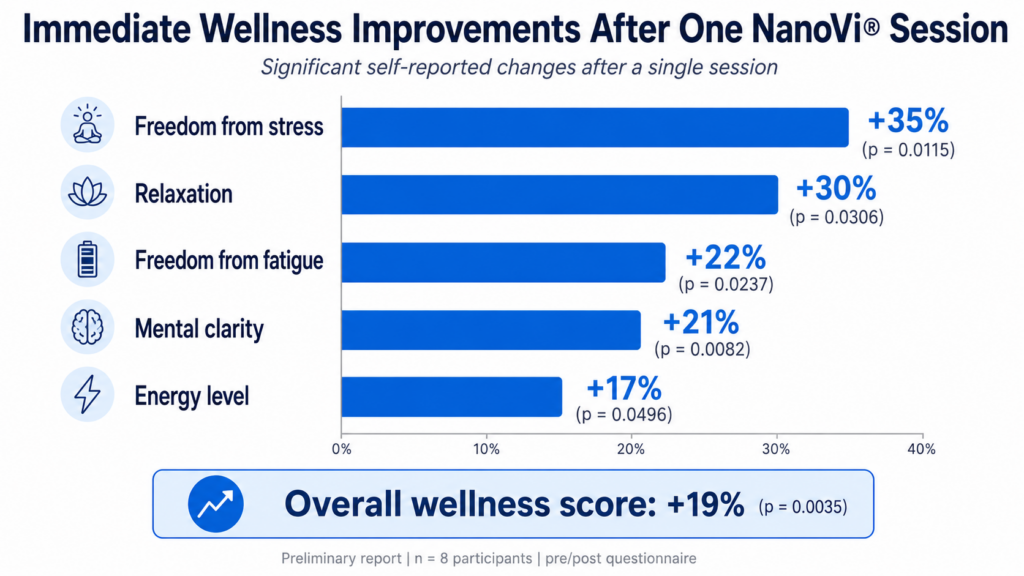
Following a single NanoVi® session, all ten wellness measures improved compared with baseline.
The largest improvements were observed in:
- Freedom from stress: +35% (p=0.0115)
- Relaxation: +30% (p=0.0306)
- Mental clarity: +21% (p=0.0082)
- Freedom from fatigue: +22% (p=0.0237)
- Energy level: +17% (p=0.0496)
The overall wellness score increased by 19%, a statistically significant improvement (p=0.0035). Although not every individual outcome reached statistical significance, all ten wellness measures showed positive changes after the session.
Why It Matters
Cellular resilience plays an important role in supporting energy, mental clarity, and overall well-being.
These preliminary findings suggest that a single NanoVi® session may be associated with immediate improvements across multiple self-reported wellness domains. The greatest benefits were observed for stress reduction, relaxation, mental clarity, reduced fatigue, and overall wellness.
As noted by the authors, these findings should be interpreted cautiously because of the small sample size and the preliminary nature of the study. Larger investigations will be needed to determine whether these improvements are consistently observed across broader populations.
Read the full article: Click here