


Highlights
- The study highlights the critical role of water in protein formation and stability.
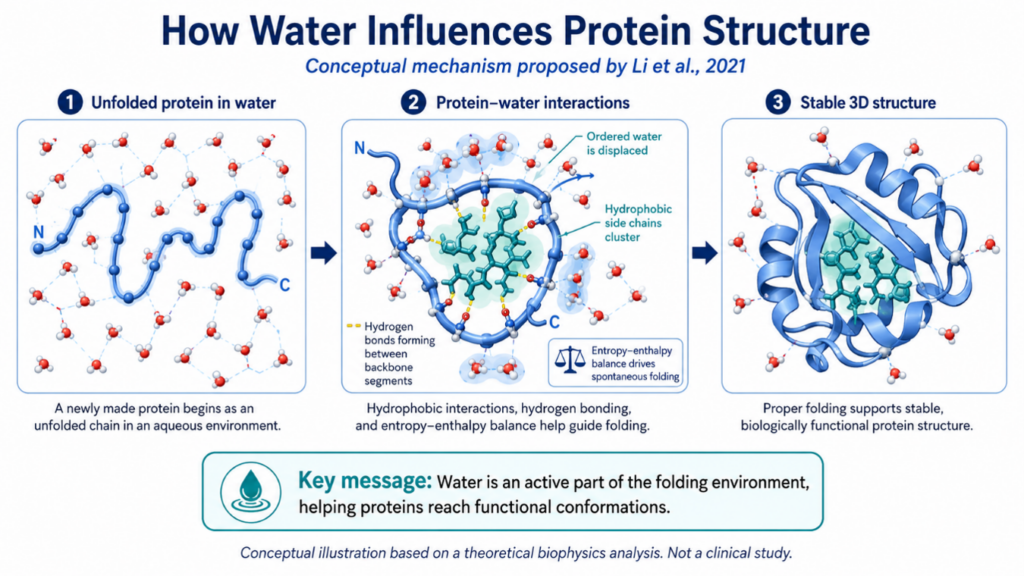
- Protein-water interactions help guide proper protein folding.
- Entropy-enthalpy balance is essential for the organization of biological structures.
- Maintaining protein integrity is an important component of cellular health and healthy aging.
Study Design
Li and colleagues published a theoretical biophysics analysis exploring how proteins acquire their functional three-dimensional structures. The work focused on the thermodynamic mechanisms involved in protein folding, particularly the interaction between proteins and surrounding water molecules.
The authors analyzed experimentally characterized protein structures and proposed a model describing how hydrophobic interactions, hydrogen bonding, and entropy-enthalpy compensations contribute to the folding process.
What Did They Find?
The researchers found that water plays a far more active role in protein folding than traditionally appreciated. According to their model, water molecules participate in molecular organization by influencing interactions between different regions of a protein.
The study suggests that proper protein folding occurs through a delicate balance of energetic forces that promote hydrogen bond formation and hydrophobic interactions, allowing proteins to adopt stable and biologically functional conformations.
The authors concluded that protein-water interactions are fundamental components of the molecular architecture required for normal cellular function.
Why It Matters
Proteins perform virtually every biological function within the body. To function properly, they must maintain their correct three-dimensional structure.
This study reinforces the importance of the aqueous environment surrounding proteins and highlights how subtle changes in protein-water interactions may influence fundamental cellular processes.
Understanding these mechanisms is particularly relevant to research focused on cellular health, biological performance, and healthy aging, where preserving protein structure and function remains a key scientific objective.
Reference: Li J, Hou C, Ma X, et al. Entropy-Enthalpy Compensations Fold Proteins in Precise Ways. Int J Mol Sci. 2021;22(17):9653. Published 2021 Sep 6. doi:10.3390/ijms22179653
Link to the study: Click here