
Highlights
- Left and right Flow Gain increased by 265% and 224%.
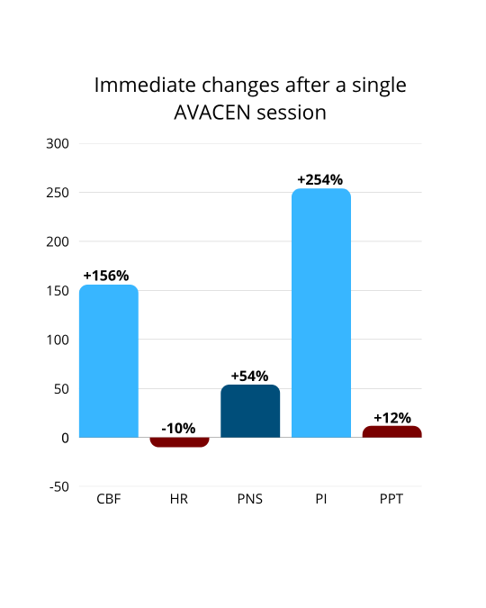
- Perfusion Index increased by 254%.
- A brain blood flow-related proxy increased by 156%.
- Peripheral pulse transit time increased by 12%, alongside other circulation-related changes.
A 63-year-old participant completed one 20-minute AVACEN session as part of an exploratory assisted living facility study. Researchers measured brain blood flow-related parameters, heart rate, autonomic activity, peripheral circulation, and self-reported wellness before and immediately after the session.
A pronounced circulation-related response
One of the most noticeable findings in this case involved peripheral circulation.
Bilateral Flow Gain is a measure used to observe changes in peripheral blood flow-related activity on the left and right sides. After the session, Flow Gain increased by 265% on the left and 224% on the right.
The Perfusion Index, which provides information related to blood flow reaching peripheral tissues, increased from 3.0% to 10.6%—a 254% increase.
Another measurement, peripheral pulse transit time (PPT), increased from 100.8 to 113.3 ms, representing a 12% increase. PPT reflects the time it takes for the pulse wave generated by each heartbeat to travel through the peripheral circulation. Changes in this measure provide additional information about vascular and circulatory behavior following the session.
Taken together, the increases in Bilateral Flow Gain, Perfusion Index, and PPT indicate a measurable short-term peripheral circulation and vascular response. These findings are particularly interesting because AVACEN uses a localized hand-based application, while substantial circulation-related changes were observed on both sides.
A brain blood flow-related measure also changed
Researchers used a non-invasive cerebral blood flow proxy to observe changes related to blood flow in the brain. This is an indirect measure rather than a direct measurement of cerebral blood flow.
The participant’s proxy value increased from 48 to 123—a 156% increase.
Adequate cerebral blood flow is important because blood delivers the oxygen and nutrients needed for normal brain activity. An increase from a low starting value can therefore be an interesting physiological observation, although this result does not demonstrate improved brain function.
A shift in heart rate and autonomic activity
Mean heart rate decreased by 10%, from 87.5 to 78.9 beats per minute.
The autonomic nervous system automatically regulates functions such as heart rate and blood vessel activity. Its sympathetic branch is associated with greater activation or “fight-or-flight,” while the parasympathetic branch supports the body’s “rest-and-recover” state.
After the session, the participant’s sympathetic-related measure decreased by 17%, while the parasympathetic-related measure increased by 54%. Together with the lower heart rate, this pattern suggests a short-term shift toward greater parasympathetic influence.
The participant also reported feeling better
The participant’s self-reported total wellness score increased from 27 to 31, representing a 15% improvement immediately after the session.
This case represents one individual’s immediate response and cannot predict how others will respond to AVACEN. Still, the combination of bilateral Flow Gain changes, increased peripheral perfusion and PPT, changes in a brain blood flow-related measure, and a shift in autonomic activity makes this an interesting case for continued investigation.