
Highlights
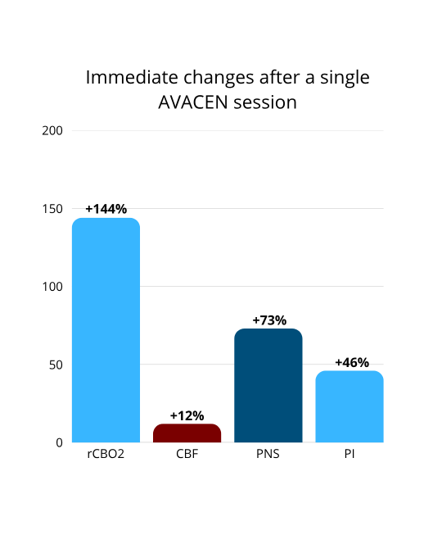
- Regional cerebral blood oxygenation increased by 144%.
- A cerebral blood flow-related proxy increased by 12%.
- A parasympathetic-related measure increased by 73%.
- Perfusion Index increased by 46%.
A 52-year-old participant completed one 20-minute AVACEN session during an exploratory assisted living facility study. Researchers performed non-invasive measurements immediately before and after the session to examine brain blood flow and oxygenation-related measures, heart rate, autonomic activity, and peripheral perfusion.
What does brain oxygenation tell us?
The brain requires a continuous supply of oxygen to support normal cellular activity. That oxygen is carried to brain tissue by the blood.
Researchers therefore assessed regional cerebral blood oxygenation, a non-invasive measurement related to the presence of oxygenated blood in the brain region being examined.
For this participant, the value increased from 19.6 to 47.8 after the session—a 144% increase.
A separate cerebral blood flow proxy, which indirectly reflects changes related to brain blood flow, increased by 12%.
The oxygenation change is particularly interesting because the participant began with a comparatively low value. However, more is not automatically better at every starting level, and these measurements do not demonstrate that brain function itself improved.
What happened to the body’s automatic “stress and recovery” system?
The autonomic nervous system automatically regulates processes such as heart rate and blood vessel activity.
Its sympathetic branch is associated with greater activation or “fight-or-flight,” while its parasympathetic branch supports the body’s “rest-and-recover” state.
Following the AVACEN session, the participant’s sympathetic-related measure decreased by 6%, while the parasympathetic-related measure increased by 73%. Mean heart rate also decreased by 5%.
Together, these findings suggest an acute shift toward greater parasympathetic influence.
Peripheral perfusion also increased
Perfusion refers to the delivery of blood to body tissues. The participant’s Perfusion Index, a measure related to peripheral blood flow, increased by 46% following the session.
This case describes a single participant’s short-term response. It does not demonstrate that the same changes occur in everyone, but it provides another example of measurable physiological changes immediately following one AVACEN session.