
Highlights
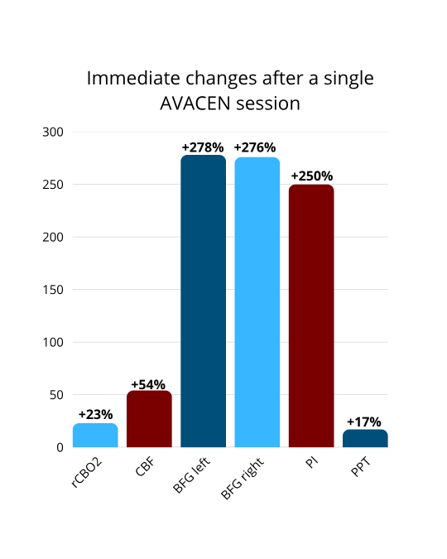
- Left and right Flow Gain increased by 278% and 276%.
- Perfusion Index increased by 250%.
- A brain blood flow-related proxy increased by 54%.
- Peripheral pulse transit time increased by 17%, alongside other circulation-related changes.
A 53-year-old participant completed a single 20-minute AVACEN session as part of an exploratory study in an assisted living facility. Researchers measured brain oxygenation and blood flow-related parameters together with peripheral circulation immediately before and after the session.
Changes in brain blood flow and oxygenation-related measures
The brain relies on blood to provide a continuous supply of oxygen and nutrients needed for normal activity.
Researchers measured regional cerebral blood oxygenation, which provides information about oxygenated blood in the brain region being assessed, along with a cerebral blood flow proxy, an indirect measure related to changes in brain blood flow.
After the AVACEN session, regional cerebral blood oxygenation increased from 49.3 to 60.7, a 23% increase. The cerebral blood flow proxy increased from 116 to 179, representing a 54% increase.
These findings indicate an immediate change in cerebral hemodynamic-related measurements. Because adequate blood flow and oxygen delivery are essential for normal brain activity, these changes are interesting from a physiological perspective. However, they do not, by themselves, demonstrate improved cognition or brain performance.
A particularly strong bilateral circulation response
The largest changes in this case involved peripheral circulation.
Bilateral Flow Gain is a measure used to observe changes in peripheral blood flow-related activity on the left and right sides. After the session, Flow Gain increased from 82.5 to 311.6 on the left and from 105.9 to 398.1 on the right. These represent increases of 278% and 276%, respectively.
The Perfusion Index, another measure related to blood flow reaching peripheral tissues, increased from 0.8% to 2.8%, representing a 250% increase.
Another circulation-related measurement, peripheral pulse transit time (PPT), increased from 75.6 to 88.5 ms, a 17% increase. PPT reflects the time it takes for the pulse wave generated by each heartbeat to travel through the peripheral circulation. Changes in this measure provide researchers with additional information about vascular and circulatory behavior following the session.
Taken together, the increases in Bilateral Flow Gain, Perfusion Index, and PPT indicate a measurable short-term peripheral circulation and vascular response.
Why is the bilateral response particularly noteworthy? AVACEN was applied locally to the hand, yet substantial circulation-related changes were measured on both sides. This suggests that, for this participant, the measured response was not confined only to the immediate area where AVACEN was applied.
This is an individual case and cannot tell us how other people will respond to AVACEN. Still, the combination of bilateral peripheral circulation changes and brain blood flow and oxygenation-related changes makes this an interesting acute response for future research to explore.