

Highlights
- This randomized, double-blind, controlled clinical trial evaluated auricular vagus nerve photobiomodulation (PBM) in adults with mild cognitive impairment (MCI).
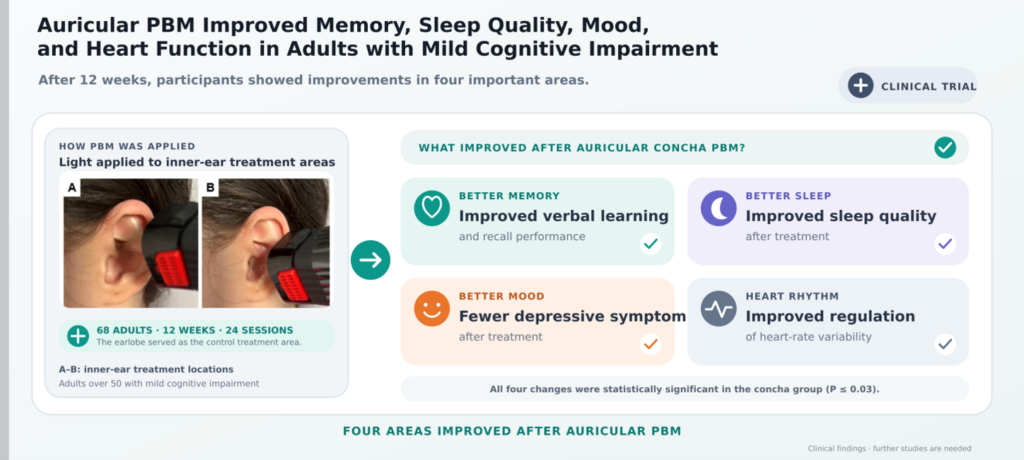
- Participants receiving auricular vagus nerve photobiomodulation demonstrated improvements in cognitive performance, with positive trends also observed for memory, mood, and sleep.
- The active treatment also improved delayed verbal memory, reduced depressive symptoms.
- Treatment consisted of 24 sessions over 12 weeks using laser photobiomodulation applied to the auricular branch of the vagus nerve.
- These findings support auricular PBM as a promising, non-invasive neuromodulation strategy for cognitive health and healthy aging.
Background
Mild Cognitive Impairment (MCI) represents an intermediate stage between normal aging and dementia, with a substantially increased risk of progression to Alzheimer’s disease. Although vagus nerve stimulation has demonstrated cognitive benefits, no published clinical trial had previously investigated photobiomodulation applied to the auricular branch of the vagus nerve for this purpose. This study evaluated whether auricular PBM could improve cognition and related clinical outcomes in adults with MCI.
Study Design
This randomized, double-blind, controlled clinical trial included adults 50 to 79 years of age diagnosed with mild cognitive impairment.
Treatment protocol:
- Treatment target: Auricular branch of the vagus nerve (concha)
- Control: Laser applied to the earlobe
- Treatment duration: 12 weeks
- Total sessions: 24
The primary outcome was cognitive performance. Secondary outcomes included verbal and visual memory, executive function, depression, anxiety, sleep quality, prefrontal cortex hemodynamics, heart rate variability, and body composition.
Key Findings
Following treatment:
- The auricular concha group demonstrated a 2.0 ± 2.4-point improvement in Montreal Cognitive Assessment (MoCA) scores compared with 1.0 ± 2.92 in the control group.
- Delayed verbal memory (RAVLT Delayed Recall) also improved in the auricular PBM group.
- Participants receiving auricular PBM showed a significant reduction in depressive symptoms (p = 0.003).
- Sleep quality improved significantly compared with the control group (p = 0.03).
- Although the between-group cognitive difference did not reach statistical significance, the overall findings demonstrated consistent positive trends across multiple clinically relevant outcomes.
Potential Clinical Applications
The results suggest that auricular vagus nerve photobiomodulation may become a valuable complementary therapy for:
- Mild cognitive impairment (MCI)
- Healthy cognitive aging
- Early intervention strategies for dementia risk
- Mood support
- Sleep quality improvement
- Non-invasive neuromodulation
Larger multicenter clinical trials are warranted to confirm these findings and establish optimal treatment protocols.
Takeaway
This randomized double-blind clinical trial provides encouraging evidence that auricular vagus nerve photobiomodulation may improve cognitive performance while also reducing depressive symptoms and enhancing sleep quality in adults with mild cognitive impairment. As a safe and non-invasive neuromodulation approach, auricular PBM represents a promising strategy for supporting cognitive health during aging and deserves further investigation in larger clinical studies.
Reference: Dutra AR. Effects of Photobiomodulation of the Auricular Branch of the Vagus Nerve on Cognition in Individuals with Mild Cognitive Impairment: A Randomized Double-Blind Controlled Clinical Trial. Master’s Dissertation. Graduate Program in Health Sciences, University of Southern Santa Catarina (UNISUL), 2024.
Link to the full dissertation: Click here