


Highlights
- Acupuncture and laser acupuncture show effectiveness in reducing pain in temporomandibular disorders (TMD).
- Laser acupuncture demonstrates high efficacy compared to placebo in meta-analysis.
- Acupuncture appears beneficial mainly in short-term pain reduction.
- Evidence quality remains limited due to small sample sizes and risk of bias.
- Laser acupuncture emerges as a promising non-invasive alternative.
Background and Rationale
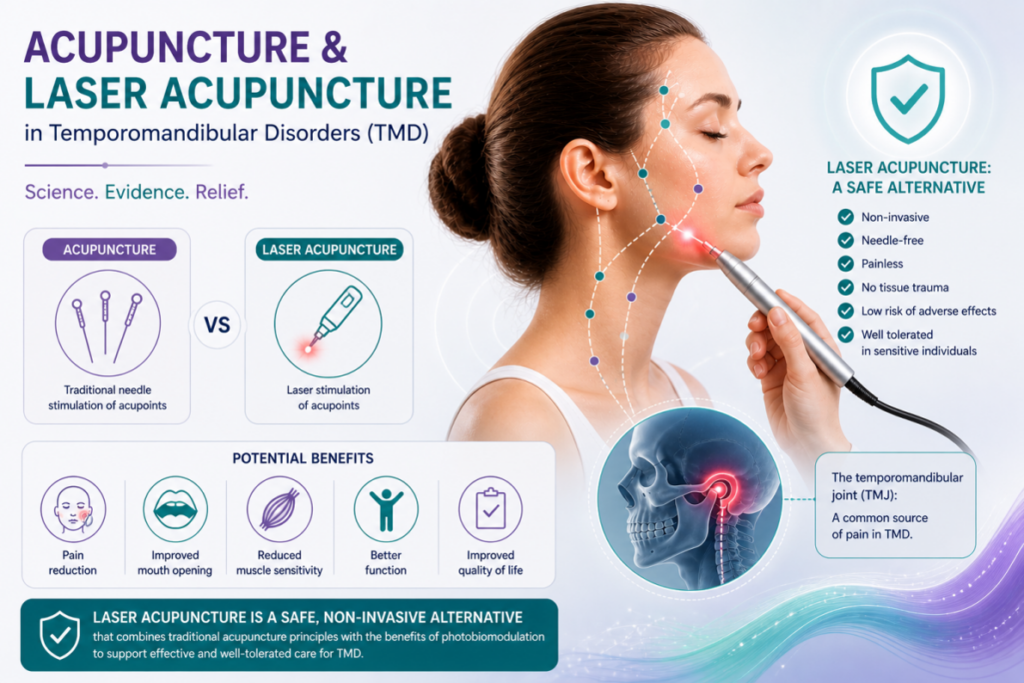
Temporomandibular disorders (TMD) encompass a range of conditions affecting the temporomandibular joint, masticatory muscles, and surrounding tissues, often leading to chronic orofacial pain. Conservative and non-invasive therapies are typically preferred as first-line approaches. Among these, acupuncture has been widely used, while laser acupuncture has gained attention as a modern, needle-free alternative that combines traditional meridian stimulation with photobiomodulation.
Key Mechanisms and Clinical Differences
Traditional Acupuncture
- Mechanical stimulation of acupoints
- Activation of neurophysiological pathways
- Modulation of endogenous opioids and neurotransmitters
Laser Acupuncture
- Photonic stimulation of acupoints without needles
- Activation of mitochondrial pathways (cytochrome c oxidase)
- Increased ATP production and modulation of inflammation
- Non-invasive, painless, and safer in sensitive populations
Evidence from Clinical Studies
A systematic review and meta-analysis including 11 randomized controlled trials evaluated acupuncture and laser acupuncture in TMD patients.
Key findings:
- Both acupuncture and laser acupuncture were more effective than placebo
- Acupuncture showed short-term pain reduction benefits
- Laser acupuncture demonstrated strong and consistent efficacy in pain reduction
- Improvements were also observed in:
- Mouth opening
- Muscle sensitivity
- Functional outcomes
The meta-analysis revealed a significantly higher efficacy rate for laser acupuncture compared to placebo, reinforcing its clinical relevance.
Clinical Interpretation
While acupuncture shows clinical utility, particularly for short-term symptom relief, the evidence suggests that laser acupuncture may provide a more consistent and clinically relevant benefit. Its non-invasive nature, ease of application, and favorable safety profile make it particularly attractive for modern integrative practice.
Takeaway
Laser acupuncture represents a promising evolution of traditional acupuncture, combining established therapeutic principles with modern photobiomodulation. Despite encouraging results, further high-quality trials are needed to establish optimal parameters and long-term efficacy.
Reference: Di Francesco, F., Minervini, G., Siurkel, Y., Cicciù, M., & Lanza, A. (2024). Efficacy of acupuncture and laser acupuncture in temporomandibular disorders: a systematic review and meta-analysis of randomized controlled trials. BMC oral health, 24(1), 174. https://doi.org/10.1186/s12903-023-03806-1
Read the full paper: Click here