


Highlights
- Water surrounding proteins is not simply passive—it is closely connected to protein structure, stability, and function.
- When proteins were denatured, or lost their normal folded structure, the organization of the water surrounding them changed significantly.
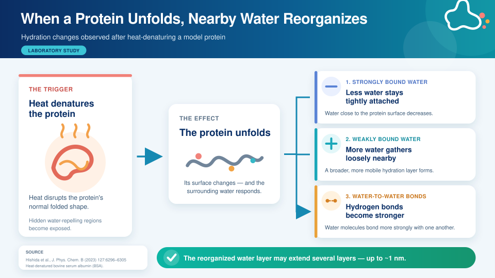
- Researchers found less strongly bound water but more weakly bound water around proteins after denaturation.
- These findings reveal an important connection between protein structure, water organization, and molecular stability.
Study Design
Hishida et al. (2023) investigated something that happens at an extremely small scale: how the water immediately surrounding a protein changes when that protein loses its normal structure.
Proteins normally fold into specific shapes that allow them to perform their biological functions. When this structure is disrupted—a process known as denaturation—parts of the protein that are normally hidden can become exposed to the surrounding water.
The researchers used bovine serum albumin (BSA) as a model protein and induced denaturation through heat. They then used three complementary laboratory techniques—terahertz spectroscopy, thermal measurements, and infrared spectroscopy—to examine different aspects of the water surrounding the protein.
This surrounding layer is called hydration water. In simple terms, these are water molecules whose behavior is influenced by their proximity to a protein.
What Did They Find?
When Protein Structure Changed, the Water Around It Changed Too
The researchers found that protein denaturation produced a clear change in the surrounding hydration environment.
The amount of strongly bound water decreased, while the amount of weakly bound water increased.
What does that mean?
Strongly bound water refers to water molecules that are more tightly associated with the protein’s surface, mainly around water-friendly—or hydrophilic—regions.
Weakly bound water, on the other hand, extends farther from the protein and can also surround water-repelling—or hydrophobic—regions.
When the protein unfolded, previously hidden hydrophobic regions became exposed. The researchers found that this structural change was accompanied by an increase in weakly bound water around these newly exposed regions.
The Organization of Water Molecules Also Changed
The changes went beyond the amount of water surrounding the protein.
Infrared spectroscopy revealed that hydrogen bonds between water molecules became stronger after protein denaturation. Hydrogen bonds are interactions that help water molecules organize and interact with one another.
The researchers propose that these stronger water-to-water interactions help explain why more weakly bound hydration water forms around exposed hydrophobic regions of a denatured protein.
So, when protein structure changes, the microscopic organization and movement of the surrounding water change with it.
Hydration and Protein Stability Are Closely Connected
One of the most interesting findings is that the hydration environment can extend beyond the molecules directly touching the protein.
The researchers suggest that weakly bound hydration water can extend through several molecular layers—as far as approximately 1 nanometer from the protein surface—and may contribute to the energetic balance associated with protein stability.
This highlights an important concept: understanding protein stability requires looking not only at the protein itself, but also at the molecular environment surrounding it.
Why It Matters
Proteins are essential to virtually every biological process, and their ability to work properly depends heavily on maintaining the right three-dimensional structure.
This study adds another piece to that puzzle by showing that protein structure and surrounding water are deeply interconnected. When a protein loses its normal folded state, the organization, movement, and bonding behavior of nearby water molecules also change.
Rather than viewing water as simply the background in which proteins exist, these findings show that hydration is an active part of the molecular environment associated with protein stability and function. The authors specifically emphasize that understanding both strongly and weakly bound hydration water is important for accurately describing protein hydration.
The broader message is simple but powerful: maintaining molecular balance involves more than the protein alone—it also involves the environment immediately surrounding it.
Reference: Hishida M, Kaneko A, Yamamura Y, Saito K. Contrasting Changes in Strongly and Weakly Bound Hydration Water of a Protein upon Denaturation. J Phys Chem B. 2023;127(28):6296-6305. doi:10.1021/acs.jpcb.3c02970
Read the full article: Click here