


Highlights
- Hydrogen-rich water was associated with lower oxidative stress in people with chronic hepatitis B.
- The hydrogen group showed higher levels of protective antioxidant enzymes.
- Markers linked to oxidative damage became lower after the intervention.
- The approach appeared safe during the 6-week study period.
Study Design
This study was a randomized, controlled, blinded clinical trial involving 60 people with chronic hepatitis B.
Participants were divided into two groups:
- Control group: routine treatment
- Intervention group: routine treatment plus hydrogen-rich water
The hydrogen-rich water group drank 1200 to 1800 mL per day for 6 weeks.
Researchers looked at several outcomes, including:
- Oxidative stress markers, which can help show the balance between damage from reactive molecules and the body’s defense systems
- Liver function markers, which can give insight into how well the liver is working
- Viral load (HBV DNA), which reflects the amount of hepatitis B virus detected in the body
What Did They Find?
The researchers observed several changes in the group that received hydrogen-rich water.
- Higher SOD and GST
These are antioxidant enzymes, which are part of the body’s natural defense system against oxidative stress.
- Lower MDA and XOD
These markers are associated with oxidative damage and oxidative activity in the body. Lower levels may suggest less oxidative stress.
- Changes in liver-related markers
The hydrogen group showed lower ALT and total bilirubin (TBiL), along with higher cholinesterase (ChE). These markers are commonly used to assess liver status.
- Reduction in HBV DNA
Viral load decreased in the hydrogen group, although the difference compared with the control group was not strongly statistically significant.
Why It Matters
Oxidative stress is thought to play a role in many chronic health conditions, including liver-related conditions. In simple terms, oxidative stress happens when harmful reactive molecules build up faster than the body can manage them.
This study suggests that hydrogen-rich water may help support the body’s antioxidant defenses in people with chronic hepatitis B. It also suggests there may be possible benefits related to liver health markers.
What makes molecular hydrogen especially interesting is that it has been studied as a selective antioxidant. That means it may help reduce some of the most damaging reactive molecules without interfering too much with normal cell signaling, which the body still needs.
These findings are encouraging, but they should be understood within the scope of this single 6-week study.
Key Insight
👉 In this study, hydrogen-rich water was associated with lower oxidative stress and favorable changes in several liver-related markers in people with chronic hepatitis B.
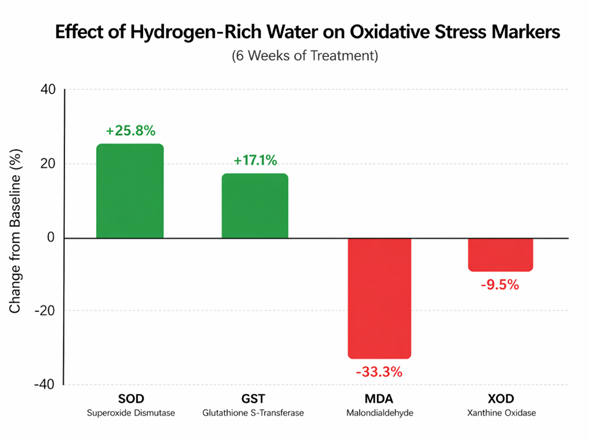
Effect of hydrogen-rich water on oxidative stress markers after 6 weeks of intervention.
Percent change from baseline is shown for key biomarkers in patients receiving hydrogen-rich water. Antioxidant enzymes increased (SOD: +25.8%; GST: +17.1%), while markers of oxidative damage decreased (MDA: −33.3%; XOD: −9.5%). Positive values (green) indicate improved antioxidant defense, and negative values (red) indicate reduced oxidative stress.
Reference: Xia C, Liu W, Zeng D, Zhu L, Sun X, Sun X. Effect of hydrogen-rich water on oxidative stress, liver function, and viral load in patients with chronic hepatitis B. Clin Transl Sci. 2013;6(5):372-375. doi:10.1111/cts.12076