


Highlights
- Transcranial PBM increased cerebral blood flow and oxygenation.
- Improvements were observed in memory, planning, and processing speed.
- Depressive symptoms were reduced following PBM.
- Effects were more pronounced in the left hemisphere.
- PBM was safe and feasible in chronic severe TBI patients.
Background
Traumatic brain injury (TBI) often leads to long-term cognitive and psychological impairments. Enhancing cerebral perfusion and metabolic activity represents a potential therapeutic pathway for cognitive rehabilitation.
Intervention
Ten individuals with chronic severe TBI received transcranial PBM:
- Wavelength: 630 nm (LED clusters)
- Device: 13 clusters of 4 red LEDs
- Total scalp area: ~400 cm²
- Frequency: 3 sessions per week for 6 weeks
Assessments were conducted at baseline, one week post-treatment, and three months post-treatment.
Key Findings
- Increased cerebral blood flow and oxygenation, particularly in the left hemisphere.
- Improvements in episodic, verbal, and visual memory, as well as executive function.
- Reduction in depressive symptoms, with minimal anxiety changes.
- No adverse effects reported.
Takeaway
Transcranial PBM shows potential as a supportive tool in cognitive rehabilitation after traumatic brain injury by enhancing cerebral hemodynamics and functional recovery. Larger controlled studies are warranted.
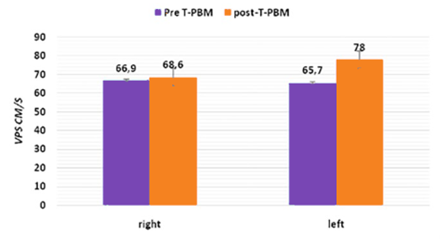
Figure 1. Histogram of comparative PSV of right and left hemispheres, pre- and post-PBM. PSV – peak systolic velocity.
Reference: Carneiro AMC, Poiani GC, Zaninnoto AL, Lazo Osorio R, Oliveira ML, Paiva WS, Zângaro RA. Transcranial Photobiomodulation Therapy in the Cognitive Rehabilitation of Patients with Cranioencephalic Trauma. Photobiomodul Photomed Laser Surg. 2019; 37(10):657-666. doi: 10.1089/photob.2019.4683