


Highlights
- In a randomized, double-blind, sham-controlled study, transcranial near-infrared stimulation (tNIRS) was associated with a significant reduction in anxiety symptoms.
- Improvements were observed right after treatment and were still present at 2, 4, and 8 weeks follow-up.
- Stimulation targeted the left dorsolateral prefrontal cortex (DLPFC), a region involved in attention and emotional regulation.
- Brain network measures suggested changes in connectivity/information flow after treatment.
- The protocol was described as safe and well tolerated, with no serious adverse events reported.
Why this matters
Anxiety disorders are often linked to how the brain’s prefrontal “control” systems interact with deeper emotional circuits. Because of that, non-invasive approaches that target the prefrontal cortex are being studied as potential supportive tools alongside standard care.
What the researchers did
Participants were assigned to either active tNIRS or a sham (placebo) condition, with both participants and evaluators blinded.
tNIRS protocol:
- 820 nm near-infrared light
- Target: left DLPFC (EEG-based F5 location)
- Daily structure: four 4-minute stimulations/day, separated by 5-minute intervals
- Duration: 14 consecutive days
- Protective eyewear and standardized placement were used.
Key findings:
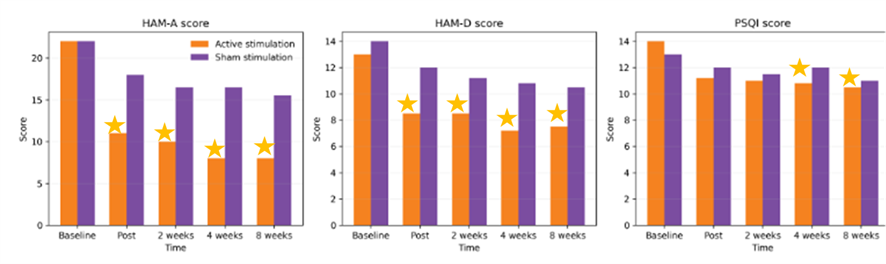
- Anxiety symptoms (HAMA): significantly improved in the active group immediately after treatment and remained improved at 2, 4, and 8 weeks.
- Mood: depressive symptoms trended toward improvement in the active group, but this was not statistically significant.
- Sleep: sleep quality showed improvement at later follow-ups.
- Brain networks (EEG): analyses suggested increased information flow involving the left DLPFC and posterior temporal regions—consistent with the idea that tNIRS may influence broader brain communication patterns.
Takeaway
This controlled trial suggests that tNIRS directed at the left DLPFC may help reduce anxiety symptoms, with effects lasting for several weeks after the intervention. While more studies are needed to confirm best parameters and long-term outcomes, these findings support tNIRS as a promising, non-invasive neuromodulation approach being investigated for anxiety-related symptoms.
Reference: Wang H, Song P, Hou Y, Liu J, Hao W, Hu S, Dai X, Zhan S, Li N, Peng M, Wang H, Lin H, Wang Y. 820-nm Transcranial near-infrared stimulation on the left DLPFC relieved anxiety: A randomized, double-blind, sham-controlled study. Brain Res Bull. 2023; 200:110682. doi: 10.1016/j.brainresbull.2023.110682