


Highlights
- Randomized, double-blind, sham-controlled design.
- Significant reduction in neck pain after 3 weeks of treatment.
- Improvement in active range of motion and paravertebral muscle spasm.
- Potential role as an adjunct therapy for cervical osteoarthritis.
Study Design
This randomized, double-blind, sham-controlled clinical trial included 34 patients diagnosed with cervical osteoarthritis (COA).
PEMF therapy was administered to the whole body using a 1.8 × 0.6 m mat. Participants lay on the mat for 30 minutes per session, twice daily, for three weeks.
PEMF parameters included:
- Mean intensity: 40 µT
- Frequency range: 0.1–64 Hz
The control group received sham treatment. Outcomes assessed included pain levels, active range of motion (ROM), paravertebral muscle spasm, and the Neck Pain and Disability Scale (NPDS).
What Did They Find?
After three weeks of therapy, the PEMF group demonstrated:
- Significant reduction in pain (p < 0.001)
- Significant improvement in active ROM
- Decreased paravertebral muscle spasm
- Significant improvement in NPDS scores
No significant changes were observed in the sham group.
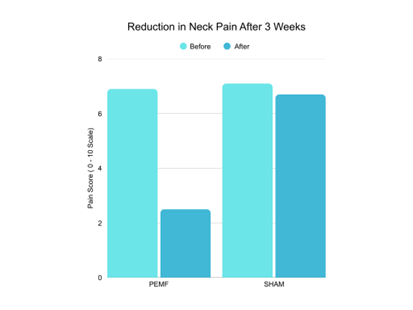
Significant reduction in neck pain was observed in the PEMF group after three weeks (6.9 → 2.5; p < 0.001).
The sham group showed no clinically meaningful change (7.1 → 6.7). The Visual Analog Scale (VAS) ranges from 0 (no pain) to 10 (maximum pain).
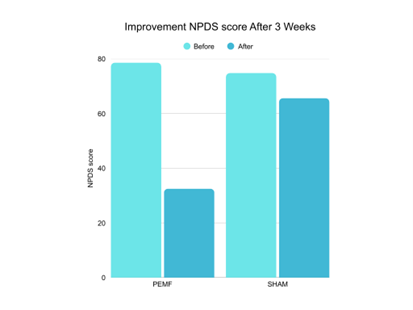
A significant improvement in neck-related disability was found in the PEMF group (78.6 → 32.5; p < 0.001).
The sham group demonstrated only a minor, non-significant change (74.8 → 65.6).
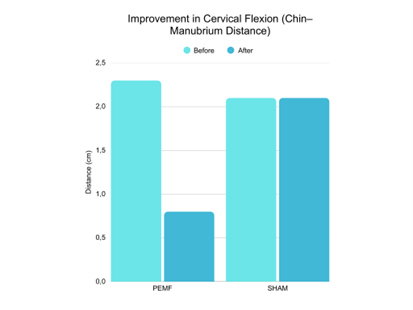
The chin–manubrium distance significantly decreased in the PEMF group (2.3 cm → 0.8 cm), indicating improved cervical flexion.
No significant change was observed in the sham group (2.1 cm → 2.1 cm).
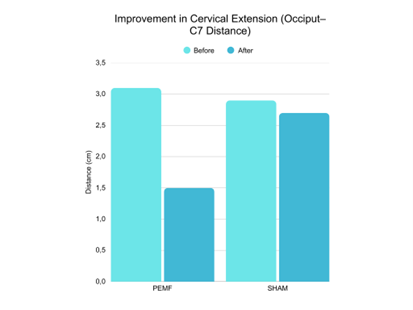
The PEMF group showed a significant reduction in occiput–C7 distance (3.1 cm → 1.5 cm), demonstrating improved cervical extension.
The sham group showed no significant improvement (2.9 cm → 2.7 cm).
Why It Matters
Cervical osteoarthritis is commonly associated with chronic pain and functional impairment. This study suggests that PEMF therapy may serve as a non-invasive adjunct to conventional treatments, with measurable improvements in pain and cervical function. Larger and longer-term studies are needed to confirm sustained clinical benefits.
Reference: Sutbeyaz ST, Sezer N, Koseoglu BF. The effect of pulsed electromagnetic fields in the treatment of cervical osteoarthritis: a randomized, double-blind, sham-controlled trial. Rheumatol Int. 2006;26(4):320-324. doi:10.1007/s00296-005-0600-3