


Highlights
- Diabetic peripheral neuropathy (DPN) involves neurovascular dysfunction and chronic pain.
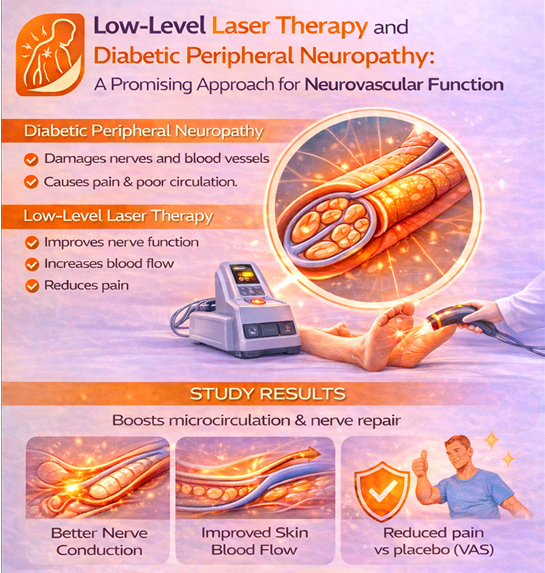
- Low-level laser therapy (LLLT) improved nerve conduction and microcirculation.
- Laser-treated patients experienced greater pain reduction than controls.
- Improvements were observed in both neural and vascular parameters.
- LLLT was safe and well tolerated.
Why this matters
DPN is a common and debilitating complication of diabetes. Because DPN is closely linked with microvascular changes (the small blood vessels that help nourish nerves), approaches that may support both circulation and nerve function are of growing interest.
The study in simple terms
Researchers enrolled 30 adults with painful diabetic peripheral neuropathy and assigned them to either:
- Active laser therapy (n=15), or
- Placebo (laser device off) (n=15).
Treatment protocol (4 weeks):
- Scanning LLLT (850 nm), energy density 5.7 J/cm²
- Applied to the plantar surface of the feet and the lumbosacral region
- 15 minutes per area, 3 sessions/week, total 12 sessions.
Key findings
1) Nerve function improved (especially sensory nerve measures)
After 4 weeks, the laser group showed significant improvements in nerve conduction parameters.
A particularly notable result was in the sural (sensory) nerve:
- Sural responses were absent in many participants at baseline, but became measurable in 100% of participants in the laser group after treatment (while remaining absent in the control group).
2) Foot microcirculation increased
Foot skin perfusion (measured at the heel, big toe, and little toe) significantly increased in the laser group, with no meaningful changes in controls.
The paper also notes an approximate ~35.8% increase in microvascular circulation compared with baseline.
3) Pain decreased more in the laser group
Pain scores decreased in both groups, but the reduction was significantly greater with laser therapy.
The paper reports an approximate ~26.4% reduction in pain over the 4-week period in the laser group.
Safety & tolerability
No significant adverse effects were reported, and the placebo design was feasible because the intervention does not produce a strong heat sensation that would easily reveal group assignment.
Takeaway
In this small placebo-controlled trial, low-level laser therapy was associated with improved neurovascular markers — including better foot microcirculation, improved nerve conduction measures, and greater pain reduction compared with placebo.
These results support LLLT as a promising, non-invasive adjunct approach that may be worth further investigation in larger and longer-term studies.
Reference: Yamany AA, Sayed HM. Effect of low level laser therapy on neurovascular function of diabetic peripheral neuropathy. Journal of Advanced Research. 2012; 3(1):21–8. doi: 10.1016/j.jare.2011.02.009.