


Highlights
- Low-level (LLLT) and high-intensity laser therapy (HILT) are both effective for musculoskeletal conditions.
- Current evidence does not support clear superiority of one modality over the other.
- LLLT may improve grip strength in specific conditions such as lateral epicondylitis.
- HILT may show advantages in tissue structure changes (e.g., tendon thickness, muscle characteristics).
- Clinical outcomes depend more on parameters and context than on intensity alone.
Background and Rationale
Musculoskeletal disorders (MSDs) are among the leading causes of pain, disability, and reduced quality of life worldwide.
Photobiomodulation (PBM), including both low-level laser therapy (LLLT) and high-intensity laser therapy (HILT), has emerged as a non-invasive therapeutic strategy widely used in rehabilitation.While both approaches rely on light–tissue interactions to modulate biological processes, an important clinical question remains: does higher intensity translate into better outcomes?
Key Mechanisms and Biophysical Differences Energy Delivery and Tissue Interaction
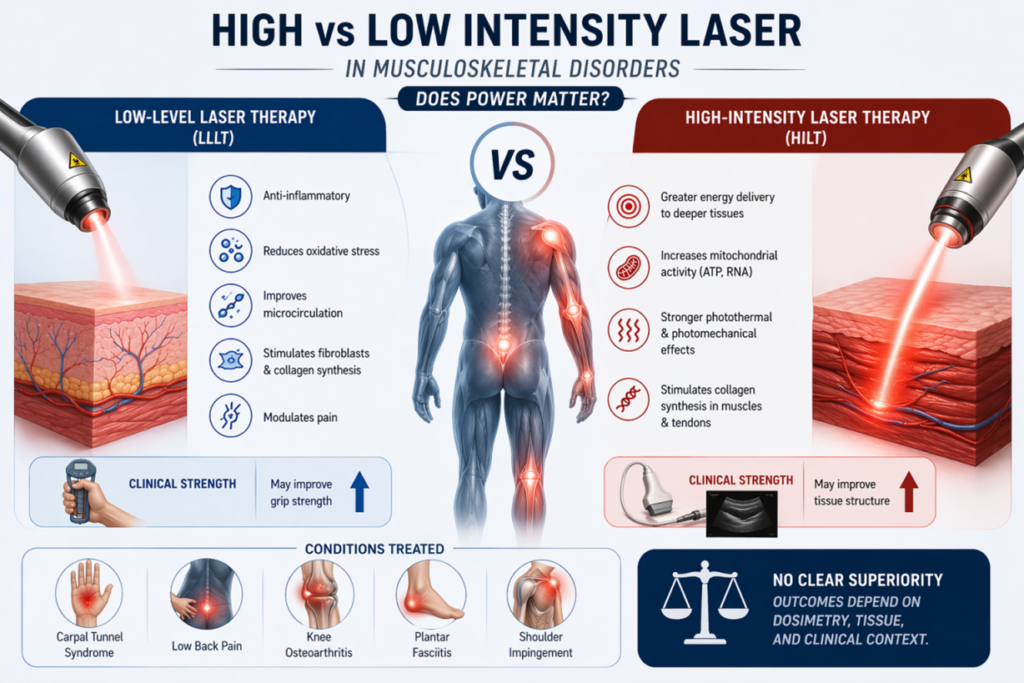
LLLT typically operates at lower power levels (mW range), promoting:
- Anti-inflammatory effects
- Modulation of oxidative stress
- Enhanced microcirculation
- Fibroblast proliferation and collagen synthesis
HILT, on the other hand, delivers higher (W range), enabling:
- Greater energy deposition in deeper tissues
- Increased mitochondrial activity (ATP, RNA synthesis)
- Stronger photothermal and photomechanical effects
Evidence from Clinical Studies
A systematic review including 12 randomized controlled trials (n = 704) evaluated HILT versus LLLT across multiple musculoskeletal conditions, including:
- Carpal tunnel syndrome
- Chronic low back pain
- Knee osteoarthritis
- Plantar fasciitis
- Subacromial impingement
Key findings:
- Pain: No significant difference between HILT and LLLT in most studies
- Function & disability: Generally similar outcomes
- Quality of life: No consistent differences
- Electrophysiology: No clear superiority
- Grip strength: Favored LLLT in pooled analysis
- Tissue structure (ultrasound): Some advantages for HILT
Clinical Interpretation
The absence of consistent superiority suggests that intensity alone is not the determining factor in PBM efficacy. Instead, outcomes are likely influenced by:
- Dosimetry (J/cm², total energy)
- Treatment duration and frequency
- Tissue type and depth
- Clinical indication
Takeaway
High- and low-intensity laser therapies should be viewed as complementary tools rather than competing modalities. The best approach is not defined by power alone, but by how well parameters are matched to the biological and clinical context.
Reference: Saleh, M. S., Shahien, M., Mortada, H., Elaraby, A., Hammad, Y. S., Hamed, M., & Elshennawy, S. (2024). High-intensity versus low-level laser in musculoskeletal disorders. Lasers in medical science, 39(1), 179. https://doi.org/10.1007/s10103-024-04111-1