


Highlights
- Dementia affects millions of people worldwide and is a leading cause of disability in older adults.
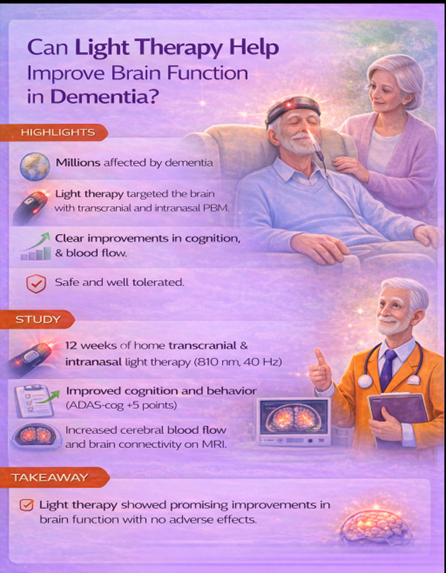
- The aim of the study was to investigate whether regular transcranial and intranasal photobiomodulation could improve cognition, behavior, cerebral blood flow, and brain network connectivity in people with dementia.
- Those who received PBM showed clear improvements compared to the control group.
- Importantly, the treatment was well tolerated, and no adverse effects were reported.
Background
- Dementia affects millions of people worldwide and is a leading cause of disability in older adults.
- Medications often provide only modest symptom relief and can have side effects, which is why researchers are exploring non drug approaches that might support brain health more gently.
- This blog post is based on a study by Chao et al. (2019), “Transcranial plus intranasal photobiomodulation therapy for dementia: A randomized, placebo controlled study,” published in Photomedicine and Laser Surgery.
- It was chosen because it offers promising findings on a home based light therapy approach that could be relevant to practitioners and caregivers seeking safe and innovative options.
- The aim of the study was to investigate whether regular transcranial and intranasal photobiomodulation could improve:
- Cognition
- Behavior
- Cerebral blood flow
- Brain network connectivity
- In people with dementia
Photobiomodulation and Intervention Protocol
- Photobiomodulation (PBM) uses low level near infrared light to gently stimulate cells in the brain.
- The light is absorbed by mitochondria, often described as the “power plants” of cells, which can:
- Boost energy production
- Improve blood flow
- PBM also appears to reduce oxidative stress and support healthier brain connectivity over time.
- In this study, light was delivered:
- Through the skull (transcranial)
- Through the nasal passages (intranasal)
- Treatment parameters:
- Wavelength: 810 nm
- Pulse frequency: 40 Hz
- Session duration: 20 minutes
- Frequency: three times per week
- Total duration: 12 weeks
Participants and Clinical Outcomes
- Eight participants with mild to moderate dementia were randomized to:
- Continue their usual care, or
- Receive PBM treatment
- Those who received PBM showed clear improvements compared to the control group.
- Cognitive testing results:
- Scores on the Alzheimer’s Disease Assessment Scale–Cognitive Subscale improved by an average of five points
- The control group declined
- Behavioral outcomes:
- Behavioral symptoms measured by the Neuropsychiatric Inventory improved significantly in the PBM group
- Symptoms worsened in the control group
Neuroimaging Findings and Safety
- Brain imaging supported the clinical findings.
- MRI scans demonstrated:
- Increased blood flow in key areas of the brain
- Particularly in parietal regions
- In participants receiving PBM
- In contrast:
- Blood flow in the control group decreased over the same period
- Functional MRI findings:
- Enhanced communication within the brain’s default mode network
- A network often disrupted in dementia
- Importantly:
- The treatment was well tolerated
- No adverse effects were reported
Interpretation
- These results suggest that PBM may help:
- Support cognition
- Improve behavior
- Enhance brain physiology
- In people with dementia
- The observed improvements in blood flow and network connectivity indicate a real biological effect rather than just symptom changes.
- This non invasive approach, administered regularly over several weeks:
- Appears to be safe
- Offers a promising avenue for future research
Takeaway
These results suggest that PBM may help support cognition, improve behavior, and enhance brain physiology in people with dementia. The observed improvements in blood flow and network connectivity indicate a real biological effect rather than just symptom changes. This non invasive approach, administered regularly over several weeks, appears to be safe and offers a promising avenue for future research.
Reference: Chao LL. Effects of Home Photobiomodulation Treatments on Cognitive and Behavioral Function, Cerebral Perfusion, and Resting-State Functional Connectivity in Patients with Dementia: A Pilot Trial. Photobiomodul Photomed Laser Surg. 2019;37(3):133-141. doi:10.1089/photob.2018.4555