

Highlights
- Traumatic brain injury (TBI) is a leading cause of disability and affects thousands of people every year
- A recent case series by Rindner et al. (2022) explored an innovative approach: transcranial infrared laser stimulation (TILS), a form of photobiomodulation that uses gentle near infrared light to stimulate the brain’s natural healing processes.
- The results of the study are encouraging. There were no reported adverse events or serious side effects, showing that TILS was well tolerated by all participants.
- These findings suggest that TILS is safe and may offer meaningful cognitive and emotional benefits for people recovering from TBI.
Background
- Traumatic brain injury (TBI) is a leading cause of disability and affects thousands of people every year.
- Even after the initial injury heals, many patients live with ongoing:
- Memory problems
- Poor concentration
- Headaches
- Mood changes
- Standard treatments often focus on symptom management, but researchers are actively looking for therapies that help the brain itself recover.
- A recent case series by Rindner et al. (2022) explored an innovative approach:
- Transcranial infrared laser stimulation (TILS)
- A form of photobiomodulation that uses gentle near infrared light to stimulate the brain’s natural healing processes.
Intervention and Protocol
- Eleven adults diagnosed with TBI received TILS sessions.
- Treatment parameters:
- Wavelength: 1064 nm
- Power density: 250 mW/cm²
- Each session involved:
- Ten minutes of laser application to each side of the frontal lobes
- Targeting Brodmann area 10
- MRI-guided neuronavigation to ensure accuracy
- Participants underwent up to eight sessions over several weeks.
- The light gently penetrates the skull and is believed to:
- Enhance mitochondrial energy production
- Improve blood flow
- Support neuronal function
- Safety procedures:
- Both patients and operators wore protective eyewear
- Sessions were carried out with care to avoid eye exposure
Results
- No reported adverse events or serious side effects.
- TILS was well tolerated by all participants.
- Main outcome measure:
- Global Rating of Change (GRC)
- Scale from −5 (“much worse”) to +5 (“much better”)
- Clinical improvements:
- Seven out of nine participants who completed the protocol reported clinically significant improvements (scores ≥ +2).
- Neurocognitive testing results:
- Verbal learning task (RAVLT):
- Eight out of eleven participants improved by at least one point (statistically significant).
- Executive function task (CWI):
- Six participants improved
- Two remained the same
- Verbal learning task (RAVLT):
- Mood assessments:
- Five participants showed reduced anxiety scores on the Beck Anxiety Inventory
- Eight participants showed improved depression scores on the Beck Depression Inventory, with several moving below clinical cutoffs
Interpretation
- These findings suggest that TILS is safe and may offer meaningful cognitive and emotional benefits for people recovering from TBI.
- Although this was a small case series without a control group:
- Results align with emerging research showing that light-based therapy can enhance cerebral oxygenation
- Supports functional recovery in the brain
- Implications:
- For patients and families: a gentle, non-drug intervention that could complement traditional rehabilitation
- For clinicians and researchers: a strong foundation for larger controlled trials to:
- Confirm efficacy
- Determine optimal timing after injury
- Refine treatment schedules
Takeaway
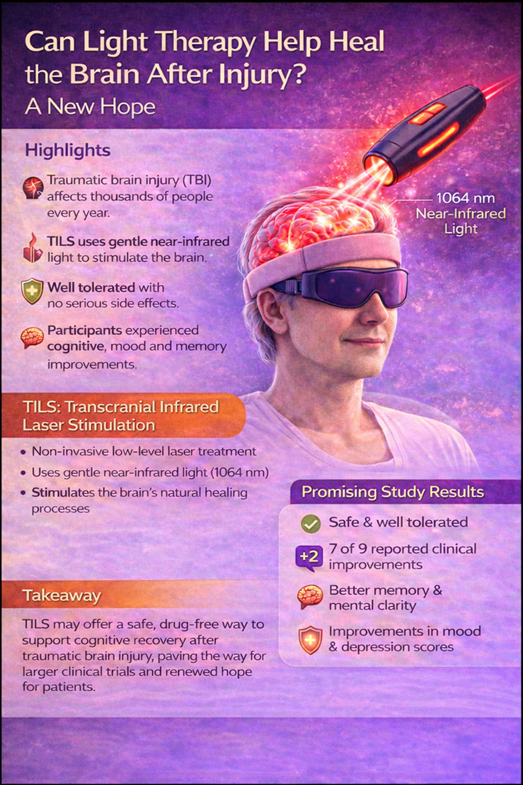
These findings suggest that TILS is safe and may offer meaningful cognitive and emotional benefits for people recovering from TBI. While this was a small case series without a control group, the results align with other emerging research showing that light based therapy can enhance cerebral oxygenation and support functional recovery in the brain.
Reference: Rindner, E. S., Haroon, J. M., Jordan, K. G., Mahdavi, K. D., Surya, J. R., Zielinski, M. A., Habelhah, B., Venkatraman, V., Becerra, S. A., Chan, L., Kuhn, T. P., & Jordan, S. E. (2022). Transcranial Infrared Laser Stimulation for the Treatment of Traumatic Brain Injury: A Case Series. Journal of lasers in medical sciences, 13, e65. https://doi.org/10.34172/jlms.2022.65