


Highlights
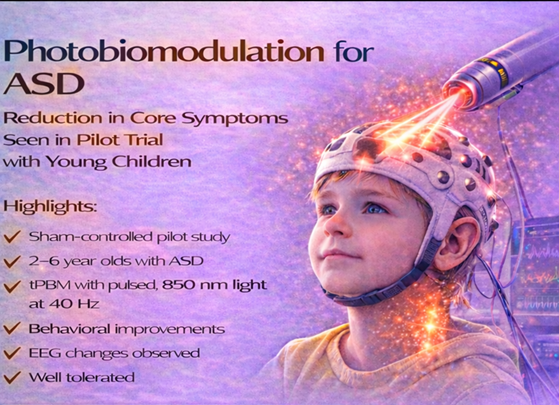
- A randomized, sham-controlled pilot trial tested whether pulsed near-infrared transcranial photobiomodulation (tPBM) could support symptoms in children with autism ages 2–6.
- Children received twice-weekly sessions for 8 weeks (about 20 minutes per session) using 850 nm light pulsed at 40 Hz.
- The active group showed a greater reduction in autism symptom severity on a standardized scale (CARS-2) compared with sham.
- EEG was feasible in a subset of children and suggested brainwave changes consistent with altered neural activity (some findings were trends).
- The intervention was well tolerated, with no moderate or severe adverse effects reported.
Why this matters
Families and clinicians rely heavily on behavioral and educational approaches for ASD. While these remain foundational, there is growing interest in supportive, non-drug options that might help regulate brain function. Transcranial photobiomodulation (tPBM) is being explored as a non-invasive neuromodulation approach, but pediatric evidence is still early.
What the study did (simple overview)
- Participants: 30 children diagnosed with ASD (ages 2–6)
- Design: randomized, double-blind, sham-controlled
- Intervention: active tPBM vs sham, 2 sessions/week for 8 weeks
- Light parameters: 850 nm, 40 Hz, ~20 minutes/session, applied to selected scalp regions
- Measurements:
- Behavioral symptoms: Childhood Autism Rating Scale – 2nd Edition (CARS-2)
- EEG (subset): only in children who tolerated the EEG cap
- Safety monitoring throughout
What the study found
1) Behavioral outcomes (main result)
Children receiving active tPBM showed a significantly larger improvement on CARS-2 than those receiving sham.
- Mean difference in score change (active vs sham): 7.23 points
- 95% CI: 2.36 to 12.11
- p = 0.011
2) EEG findings (subset; exploratory)
Among the 17 children with usable EEG data:
- Trends suggested decreased delta and increased theta over time in the active group vs sham (both p ≈ 0.07).
- Theta power was higher overall in the treatment group (p = 0.049), suggesting a measurable difference in neural activity patterns.
3) Safety
No participants experienced moderate or severe adverse effects, supporting feasibility and tolerability in this young age group.
Takeaway
This pilot randomized trial offers early, encouraging evidence that pulsed near-infrared tPBM may reduce ASD symptom severity in preschool-aged children and may also be associated with measurable brain-activity changes in those able to complete EEG testing.
Because it’s a small pilot study, the findings need confirmation in larger, multi-site trials to clarify best dosing, durability, and which children may benefit most. If replicated, tPBM could become a non-drug, well-tolerated adjunct alongside established behavioral and developmental therapies.
Reference: Fradkin Y, De Taboada L, Naeser M, Saltmarche A, Snyder W, Steingold E. Transcranial photobiomodulation in children aged 2–6 years: a randomized sham-controlled clinical trial assessing safety, efficacy, and impact on autism spectrum disorder symptoms and brain electrophysiology. Frontiers in Neurology. 2024;15:1221193. doi:10.3389/fneur.2024.1221193