


Highlights
- Blood flow increased by up to +145%
- Significant improvements in tissue oxygenation
- Dynamic physiological response from pressure cycles
- Potential role in tissue conditioning and recovery
Study Design
This experimental study evaluated the effects of negative pressure therapy (NPWT) on microcirculation in 7 healthy volunteers.
Protocol:
- Pressure: −125 mmHg
- Cycles:
- 10 minutes suction
- 10 minutes release
- Two cycles + post-measurement phase
Measured parameters:
- Blood flow
- Oxygen saturation (StO₂)
- Relative hemoglobin (rHb)
- Red blood cell velocity
What Did They Find?
🩸 Perfusion enhancement
- Blood flow increased progressively:
- +52% after suction
- up to +145% at the end
🫁 Oxygen delivery
- Oxygen saturation increased by +21.6%
- Relative hemoglobin increased by +16.7%
🔄 Key mechanism
👉 The strongest effects occurred after suction release
Indicating:
- Reactive hyperemia
- True physiological perfusion increase
Why It Matters
This study highlights a critical concept:
👉 Vacuum therapy is not passive — it actively stimulates physiology.
The alternating cycles of:
- Compression
- Reperfusion
Lead to:
⚡ Physiological effects
- Increased blood flow
- Improved oxygen delivery
- Endothelial activation
- Growth factor signaling
Strategic Insight
Vacuum therapy mimics well-known physiological mechanisms:
- Reactive hyperemia
- Shear stress-induced vascular response
- Ischemic conditioning
These are directly linked to:
- Improved circulation
- Inflammation modulation
- Tissue recovery
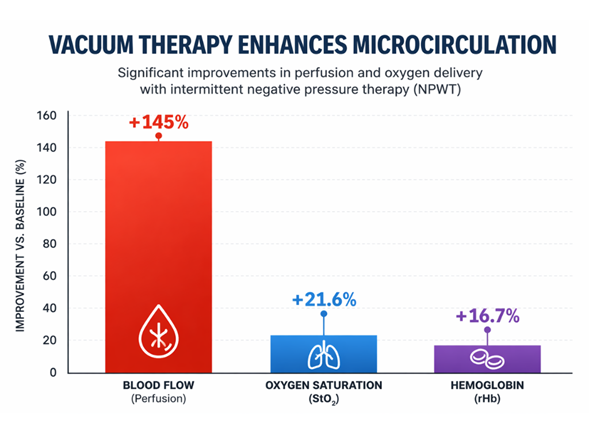
Intermittent negative pressure therapy enhances microcirculation, increasing blood flow (+145%), oxygen saturation (+21.6%), and hemoglobin levels (+16.7%).
Reference: Sogorski A, Lehnhardt M, Goertz O, et al. Improvement of local microcirculation through intermittent Negative Pressure Wound Therapy (NPWT). J Tissue Viability. 2018;27(4):267-273. doi:10.1016/j.jtv.2018.08.004