


Highlights:
- The body constantly produces reactive species as part of normal life and metabolism, but excess levels can damage cells.
- Proteostasis is the system that helps keep proteins healthy, functional, and properly balanced inside cells.
- Antioxidants, the proteasome, and autophagy work together to neutralize damage and recycle unhealthy cellular components.
- Oxidative stress occurs when damage exceeds the body’s ability to protect and repair itself, which can disrupt normal cellular function.
- Healthy aging may depend less on avoiding all damage and more on supporting the body’s natural ability to repair, adapt, and maintain balance.
Our bodies are constantly active — even when we are resting. Every second, billions of reactions take place inside our cells to produce energy, repair tissues, and keep everything functioning properly.
As part of this natural process, molecules called reactive species (often referred to as free radicals) are continuously generated. These molecules are not inherently harmful — in fact, they play important roles in normal physiology — but when present in excess, they can begin to damage the body’s own cells.
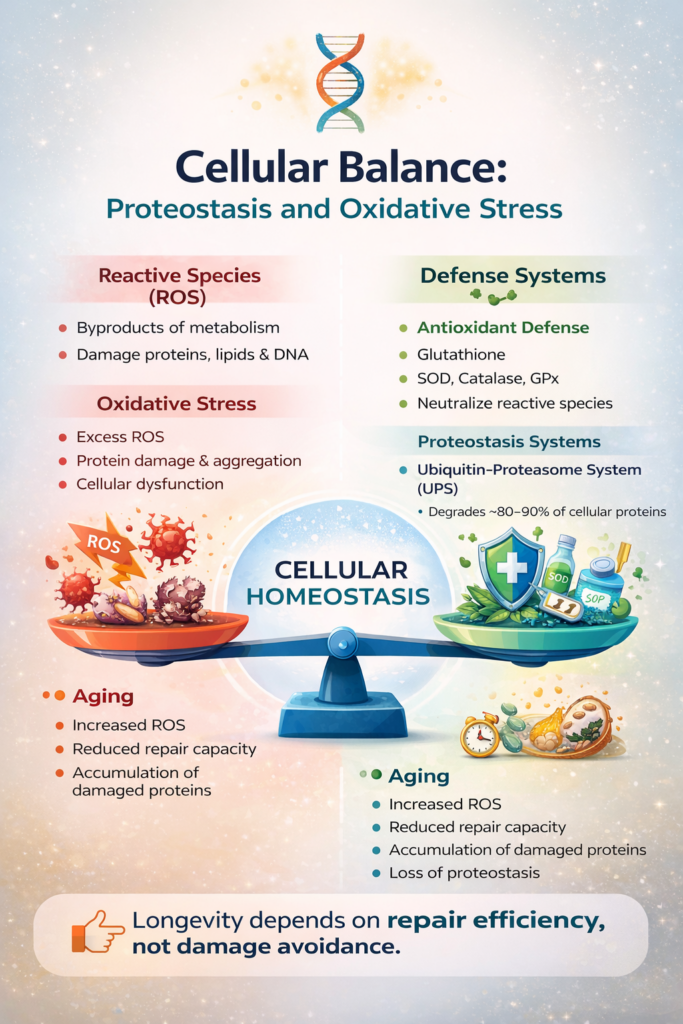
They can affect essential structures such as proteins, lipids, and even DNA. For this reason, the body relies on highly sophisticated systems to keep everything in balance. This dynamic equilibrium is known as proteostasis, which refers to the ability of cells to maintain a healthy and functional pool of proteins.
Scientific evidence shows that the production of these reactive species is unavoidable — it is a natural consequence of metabolism and life itself
The Balance That Keeps Cells Healthy
For cells to function properly, they must maintain a delicate balance between three key processes.
First, the production of reactive species.
Second, the body’s ability to neutralize them through antioxidant defenses.
And third, the capacity to repair or remove damaged components.
When these systems are in harmony, cells are able to adapt, renew themselves, and continue functioning efficiently.
How the Body Naturally Protects Itself
The body is equipped with multiple defense mechanisms to manage this constant challenge.
One of these is the antioxidant system, which includes molecules such as glutathione and specialized enzymes that help neutralize potentially harmful compounds. These systems act as a protective shield, minimizing cellular damage.
However, not all damage can be prevented. That is where cellular “cleanup” systems become essential.
Inside cells, there are highly efficient mechanisms responsible for identifying, breaking down, and recycling damaged proteins. Two of the most important systems are:
The proteasome, which acts like a molecular recycling unit and is responsible for degrading the majority of cellular proteins — approximately 80–90% of them
And autophagy, a broader recycling process that removes larger protein aggregates and even entire dysfunctional cellular components.
Together, these systems ensure that damaged material does not accumulate and interfere with normal cellular function.
What Happens During Oxidative Stress
When the production of reactive species exceeds the body’s ability to neutralize them, a condition known as oxidative stress occurs.
Under these conditions, proteins can become damaged and lose their proper structure and function. Over time, these altered proteins may accumulate and form aggregates, further disrupting cellular processes.
Research shows that when repair and degradation systems cannot keep up with the level of damage, cellular efficiency declines — a process that is closely associated with the development of many chronic conditions.
The Body’s Ability to Adapt
One of the most remarkable features of the human body is its ability to adapt.
When exposed to temporary stress, cells can respond by increasing the activity of repair and degradation systems, helping restore balance. Over time, the body may also upregulate the production of protective and repair-related proteins.
This demonstrates that the body is not passive — it is constantly adjusting, responding, and working to maintain stability.
The Role of Aging
As we age, maintaining this balance becomes more challenging.
The production of reactive species tends to increase, while the efficiency of repair and defense systems gradually declines. As a result, damaged proteins begin to accumulate within cells.
According to scientific literature, aging is closely associated with disruptions in proteostasis, including impairments in both proteasome function and autophagy
This progressive accumulation of cellular damage contributes to the decline in cellular function over time.
A New Perspective on Longevity
For many years, the focus has been on avoiding cellular damage altogether. However, modern science suggests a more strategic perspective.
👉 Longevity is not about eliminating damage — that is impossible.
👉 It is about improving the body’s ability to repair, adapt, and maintain balance.
In other words, long-term health is less about preventing stress and more about strengthening the systems that manage it.
Connecting This to Everyday Health
This understanding changes how we approach health and wellness.
Instead of focusing only on external factors, the emphasis shifts toward:
supporting the body’s natural systems,
enhancing cellular efficiency,
and promoting internal balance.
Because ultimately, health is not the absence of challenges — it is the body’s ability to respond to them effectively.
Reference: Korovila I, Hugo M, Castro JP, et al. Proteostasis, oxidative stress and aging. Redox Biol. 2017;13:550-567. doi:10.1016/j.redox.2017.07.008