

Highlights:
- Broad pre–post improvements: 9 out of 10 wellness domains improved significantly after one session (plus a significant total wellness score).
- Largest perceived change: Freedom from aches/pains improved by +56%.
- Strong relaxation + stress shifts: Relaxation (+42%) and freedom from stress (+39%) were among the biggest gains.
- Overall lift in well-being: Participants also reported meaningful increases in physical comfort, energy, and overall well-being immediately post-session.
Wellness technologies are often used to support relaxation, comfort, and a better overall sense of balance — especially during busy, high-demand routines. To better understand how people feel immediately around an inHarmony session, an ongoing online evaluation is collecting simple self-reported feedback right before and right after one session.
This approach helps capture real-time, practical impressions — the kind of changes people notice in the moment — across both emotional and physical comfort domains.
Study snapshot (ongoing evaluation)
Participants completed a short online questionnaire immediately before and immediately after a single inHarmony session. The questionnaire included 10 wellness items, each rated on a 0–5 scale, covering:
- Emotional state
- Freedom from anxiety and stress
- Relaxation and mental clarity
- Freedom from fatigue and energy level
- Freedom from aches/pains and physical comfort
- Overall sense of well-being
As of the end of the second semester of 2025, 25 people completed the pre-session questionnaire and 16 completed the post-session questionnaire. Pre–post comparisons were analyzed in GraphPad Prism with appropriate tests, using p < 0.05 as the significance threshold.
What changed after one session?
Across most outcomes, participants reported meaningful improvements immediately after a single inHarmony session. Statistically significant pre–post improvements were observed for emotional state, anxiety, stress, relaxation, fatigue, energy, aches/pain, physical comfort, overall well-being, and the total wellness score (all p ≤ 0.0164; several p < 0.0001). Mental clarity improved numerically (+15%) but did not reach statistical significance.
When looking at magnitude of perceived change, the strongest shifts were reported in:
- Freedom from aches/pains: +56%
- Relaxation: +42%
- Freedom from stress: +39%
Additional improvements were also reported in physical comfort, energy, overall well-being, and the combined total wellness score.
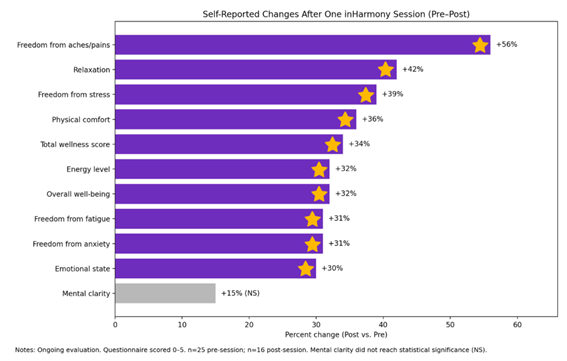
Figure 1. Self-reported percent change in wellness outcomes after a single inHarmony session (pre–post). Horizontal bars show the percent change from pre-session to post-session ratings for each questionnaire item (0–5 scale), calculated relative to the pre-session score. Purple bars indicate outcomes with statistically significant pre–post differences (p ≤ 0.0164; several p < 0.0001), while the gray bar indicates an outcome that did not reach statistical significance (NS) (mental clarity). The largest perceived change was freedom from aches/pains (+56%), followed by relaxation (+42%) and freedom from stress (+39%).
Why this matters
From a practical wellness perspective, these early results suggest that even a single inHarmony session may be associated with immediate, broad-based perceived benefits, especially in areas many people prioritize during a break or reset — comfort, relaxation, and stress reduction. Because this is an ongoing evaluation with a modest post-session sample so far, the findings should be interpreted as an early snapshot that can be strengthened as more participants complete the post-session questionnaire.
Link to full report: Read here