


Highlights
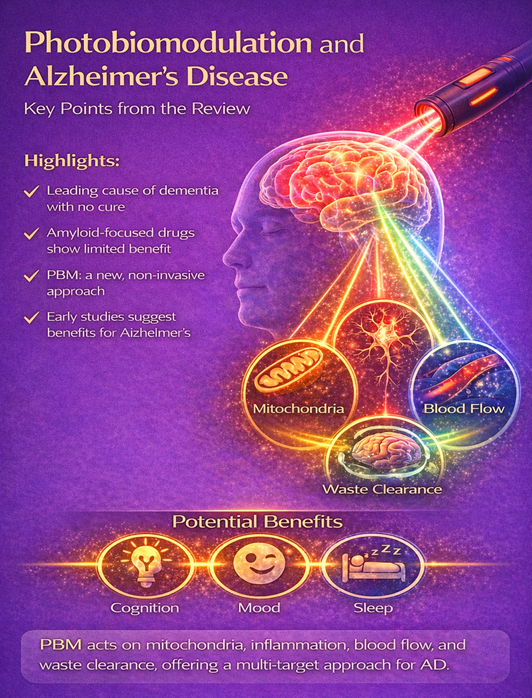
- Alzheimer’s disease (AD) is the leading cause of dementia worldwide, and there is still no cure capable of stopping its progression.
- Traditional amyloid-focused drug strategies have shown limited cognitive benefit, shifting attention toward multifactorial disease mechanisms.
- Photobiomodulation (PBM) emerges as a multi-target, non-invasive approach acting on mitochondria, inflammation, blood flow, and waste clearance.
- Early animal and human studies suggest benefits for cognition, mood, sleep, and brain metabolism.
- Larger, standardized clinical trials are still needed to define optimal treatment parameters and timing.
Understanding Alzheimer’s Disease Beyond Amyloid
Alzheimer’s disease (AD) is the leading cause of dementia worldwide, and there is still no cure or treatment capable of stopping its progression. For decades, the most accepted explanation was the beta-amyloid hypothesis, which proposes that the accumulation of Aβ plaques triggers the entire cascade of neurodegeneration. However, many clinical trials with drugs designed to remove amyloid plaques failed to produce consistent improvements in cognition.
This has shifted scientific attention to a broader understanding: Alzheimer’s is a multifactorial disease, influenced by Aβ, tau, oxidative stress, chronic neuroinflammation, vascular dysfunction, impaired glymphatic clearance, and genetic factors such as the APOE4 allele.
Where Photobiomodulation Fits In
In this context, photobiomodulation (PBM) has emerged as a promising therapeutic strategy. PBM uses low-intensity red to near-infrared light (600–1100 nm), often applied transcranially, to modulate cellular metabolism.
Its main biological target is the mitochondria, especially the enzyme cytochrome-c oxidase. When this enzyme absorbs photons, it increases ATP production, adjusts levels of reactive oxygen species (ROS), and releases nitric oxide (NO), improving both cellular energy metabolism and cerebral blood flow.
Potential Mechanisms Highlighted in the Review
According to the review, PBM may:
- Reduce oxidative stress by acting directly on mitochondrial dysfunction, one of the core drivers of neurodegeneration;
- Modulate neuroinflammation by decreasing excessive activation of microglia and astrocytes and reducing pro-inflammatory cytokine release;
- Improve cerebral blood flow through NO-mediated vasodilation, reducing hypoxia and limiting pro-amyloidogenic pathways;
- Enhance waste clearance by supporting glymphatic drainage of beta-amyloid and tau;
- Increase neurotrophic factors such as BDNF, promoting neurogenesis and synaptic plasticity.
Evidence from Animal and Human Studies
Animal and human studies suggest improvements in sleep, mood, energy, and cognitive performance following structured transcranial PBM protocols. However, the authors emphasize the need for larger, standardized clinical trials to determine ideal parameters — including wavelength, dose, frequency, and treatment duration — as well as to identify the most effective stage of the disease for intervention.
Takeaway
Rather than targeting a single mechanism such as amyloid plaques, photobiomodulation offers a multi-target approach aligned with the modern view of Alzheimer’s disease as a complex condition. Inflammation, oxidative stress, vascular dysfunction, and impaired waste clearance interact dynamically throughout disease progression.
By acting simultaneously on mitochondria, inflammation, cerebral blood flow, and brain-cleaning systems, PBM stands out as a promising therapeutic adjunct for Alzheimer’s disease — particularly in early stages — and represents an important frontier for future research.
Reference: Su M, Nizamutdinov D, Liu H, Huang JH. Recent Mechanisms of Neurodegeneration and Photobiomodulation in the Context of Alzheimer’s Disease. International Journal of Molecular Sciences. 2023;24(11):9272. Published May 25, 2023.
doi:10.3390/ijms24119272