


Highlights
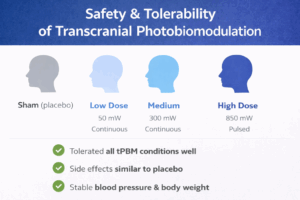
- Well tolerated at multiple settings: Participants tolerated low, medium, and high tPBM settings well.
- Side effects similar to sham: Reported symptoms were comparable to the “placebo” session.
- No meaningful vital sign changes: Blood pressure and body weight remained stable.
- Why it matters: Supports tPBM as a low-risk, non-invasive approach worth continued clinical research.
Why this study was done
Before any brain-based therapy can be taken seriously, it has to demonstrate strong safety and tolerability — especially when exploring different “doses” of light. Coelho et al. (2025) addressed this directly by testing transcranial PBM across multiple settings in adults with major depressive disorder (MDD).
Study design (simple overview)
- Participants: 31 adults (18–65) with MDD (not treatment-resistant)
- Design: randomized, single-blind, crossover trial
- Sessions: four weekly sessions per participant
- 1 sham session (placebo)
- 3 active sessions (low, medium, high “dose”)
- Target area: bilateral dorsolateral prefrontal cortex (dlPFC), corresponding to EEG sites F3/F4
- Safety tracking: SAFTEE-SI (a standard adverse-event scale in psychiatric research)
| Condition | Peak Irradiance (mW) | Mean Irradiance (mW) | Time (s) | Mean Fluence (J/cm²) | Total Energy (kJ) | Wave Mode | Frequency (Hz) |
| Sham | 0 | 0 | 0 | 0 | 0 | — | — |
| Low dose | ~50 | ~50 | 1200 | 60 | ~1.4 | Continuous | — |
| Medium dose | ~300 | ~300 | 333 | 100 | ~2.4 | Continuous | — |
| High dose | ~850 | ~300 | 600 | 180 | ~4.3 | Pulsed | ~40 |
What “dose” meant in this trial
Instead of testing just one setting, the researchers compared three active conditions:
- Low dose: longer exposure at lower irradiance (continuous mode)
- Medium dose: shorter exposure at moderate irradiance (continuous mode)
- High dose: higher-energy condition using pulsed delivery (~40 Hz)
Key safety findings
1) Side effects were not meaningfully different from placebo
Across all active conditions, adverse-event reports did not significantly increase compared with baseline or the sham session. In practical terms, participants did not report more problems during real treatment than during the “fake” session.
2) Vital signs remained stable
Measures such as blood pressure and body weight stayed consistent across sessions, supporting a favorable short-term safety profile — even at the higher setting.
3) Consistent with earlier research
The authors noted these findings align with previous reports (e.g., Cassano et al., 2019) describing a similarly benign tolerability profile for tPBM.
Strengths and limitations
Strengths
- Direct comparison of multiple settings
- Crossover design (each person serves as their own comparison)
- Structured, standardized adverse-event monitoring
Limitations
- Small sample size
- Each dose was tested only once, so long-term and cumulative effects weren’t evaluated
- Limited demographic diversity may reduce generalizability
Takeaway
This trial adds important evidence that transcranial photobiomodulation can be safe and well tolerated across a range of settings, with side-effect reports similar to placebo and no meaningful changes in basic physiological measures. Larger and longer studies are still needed, but the results support tPBM as a low-risk, non-invasive intervention that merits continued investigation in mental health research.
References:
Coelho, D. R. A., Fernando Vieira, W., Hurtado Puerto, A. M., B Gersten, M., Anne Collins, K., Peterson, A., Siu, K., Tural, Ü., Vlad Iosifescu, D., & Cassano, P. (2025). Dose-dependent tolerability and safety of transcranial photobiomodulation: a randomized controlled trial. Lasers in medical science, 40(1), 248. https://doi.org/10.1007/s10103-025-04501-z
Cassano P, Caldieraro MA, Norton R, Mischoulon D, Trinh N-H, Nyer M, Dording C, Hamblin MR, Campbell B, Iosifescu DV (2019) Reported side effects, weight and blood pressure, after repeated sessions of transcranial photobiomodulation. Photobiomodulation Photomed Laser Surg 37(10):651–656. https://doi.org/10.1089/photob.2019.4678