


Highlights
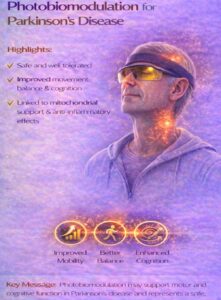
- Parkinson’s disease (PD) affects more than 10 million people worldwide, causing tremor, stiffness, slowed movement, balance problems, and cognitive decline.
- A proof of concept clinical study by Liebert et al. (2021) investigated whether PBM could safely improve motor and cognitive symptoms in people with PD.
- The findings were encouraging: PBM was well tolerated with no reported side effects.
- These results suggest that PBM may counteract the typical decline seen in PD by enhancing mitochondrial energy production, reducing inflammation, and improving blood flow — both directly in the brain and via the gut–brain axis.
Background
- Parkinson’s disease (PD) affects more than 10 million people worldwide.
- It causes:
- Tremor
- Stiffness
- Slowed movement
- Balance problems
- Cognitive decline
- Medications such as levodopa can help manage symptoms, but:
- Their effectiveness often wanes over time
- Side effects may occur
- Photobiomodulation (PBM), the application of gentle red to near-infrared light, has shown promise in:
- Animal models
- Protecting dopamine-producing neurons
- Reducing PD-related signs
Study Objective
- A proof-of-concept clinical study by Liebert et al. (2021) investigated whether PBM could:
- Safely improve motor symptoms
- Improve cognitive symptoms in people with PD
- The aim was to assess the effectiveness of a combined transcranial and remote PBM protocol involving:
- Brain
- Neck
- Abdomen
- The study also aimed to:
- Inform the design of future randomized, placebo-controlled trials
Study Design
- Participants:
- Twelve adults
- Aged 60–80 years
- Mild to moderate PD
- Group allocation:
- One group started a 12-week clinic-based PBM regimen immediately
- The second group waited 14 weeks, serving as their own controls, before starting identical treatment
PBM Protocol
- Light delivery:
- 810 nm LEDs applied to:
- Scalp
- Nasal passages (to reach the brain)
- 904 nm laser diodes applied to:
- Upper neck (around the vagus nerve)
- Abdomen (to engage the gut–brain axis)
- 810 nm LEDs applied to:
- Treatment frequency:
- 3 times per week in the first month
- 2 times per week in the second month
- 1 time per week in the final month
- After clinic treatment:
- All participants continued self-administered PBM at home
- Frequency: 3 times per week
- Duration: up to 40 weeks
Safety and Tolerability
- PBM was well tolerated
- No reported side effects
- No adverse events were observed
Motor Outcomes
- Mobility improvements:
- Timed Up and Go:
- Improved from 8.0 s to 7.1 s after 12 weeks (p < 0.01)
- Further improved to 6.6 s with extended home treatment
- Ten-meter walking speed:
- Increased from 1.12 to 1.70 m/s (p < 0.01)
- Timed Up and Go:
- Balance:
- Step test showed meaningful improvements
- Fine motor control:
- Spiral drawing test improved
- Indicated steadier hand movements
Cognitive Outcomes
- Montreal Cognitive Assessment (MoCA):
- Increased from a median score of 26 to 28 after clinic PBM (p < 0.01)
- Approached 30 after extended home treatment
- Many changes exceeded the:
- Minimal Clinically Important Difference
- Meaning participants perceived the improvements as significant
Interpretation
- PBM may counteract the typical decline seen in PD by:
- Enhancing mitochondrial energy production
- Reducing inflammation
- Improving blood flow
- Directly in the brain
- Via the gut–brain axis
- The sustained, home-based nature of PBM:
- Makes it a practical complement to medications or surgical options
Limitations and Future Directions
- Study limitations:
- Small sample size
- Lack of a sham control
- Despite this:
- Positive safety profile
- Clinically meaningful improvements
- These findings underscore the need for:
- Larger trials
- Double-blind designs
- Placebo-controlled studies
- Optimization of dosing schedules
- Evaluation of long-term outcomes
Takeaway
The sustained, home based nature of the therapy makes it a practical complement to existing drugs or surgical options. While this proof of concept study was small and lacked a sham control, its positive safety profile and clinically meaningful improvements underscore the need for larger, double blind, placebo controlled trials to confirm efficacy, optimize dosing schedules, and evaluate long term outcomes.
Reference: Liebert, A., Bicknell, B., Laakso, E. L., Heller, G., Jalilitabaei, P., Tilley, S., Mitrofanis, J., & Kiat, H. (2021). Improvements in clinical signs of Parkinson’s disease using photobiomodulation: a prospective proof-of-concept study. BMC neurology, 21(1), 256. https://doi.org/10.1186/s12883-021-02248-y