


Highlights
- Green laser PBM (≈505–532 nm) has been widely studied, but mostly in ablative or photocoagulative contexts.
- Evidence for direct activation of mitochondrial ETC complexes by green light remains limited.
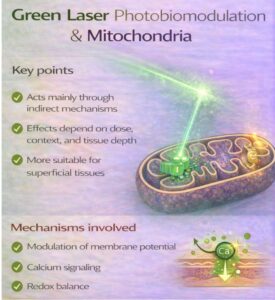
- Green laser PBM may exert indirect mitochondrial effects via membrane potential, calcium signaling, and redox modulation.
- Biological responses appear highly parameter- and context-dependent.
- Green laser shows particular relevance for superficial tissues and dermatological applications.
Background
Photobiomodulation using green wavelengths has received less attention than red and near-infrared light in mitochondrial research. While cytochrome c oxidase absorption peaks favor red/NIR wavelengths, green light may influence cellular function through alternative or indirect pathways.
Evidence from the Literature
Studies evaluating green laser PBM report:
- Mitochondrial respiration: Limited or no direct activation of ETC complexes II–IV in the presence of nitric oxide.
- Bioenergetics: Increases in mitochondrial membrane potential and oxidative phosphorylation efficiency in some models.
- Cellular signaling: Modulation of intracellular calcium, ROS production, and Na⁺/K⁺-ATPase activity.
- Inflammation and healing: Effects on cytokine expression, cell migration, collagen remodeling, and angiogenesis.
Green laser PBM has shown benefits in wound healing, dermatology, dentistry, stem cell modulation, and microcirculatory regulation, particularly in superficial tissues.
Takeaway
Current evidence does not support a clear, direct role for green laser PBM in activating specific mitochondrial ETC complexes. However, green light may influence mitochondrial-related processes indirectly and remains a promising modality for superficial tissue applications. Further mechanistic and clinical studies are needed to optimize protocols and clarify biological targets.
References:
Anwer, A. G., Gosnell, M. E., Perinchery, S. M., Inglis, D. W., & Goldys, E. M. (2012). Visible 532 nm laser irradiation of human adipose tissue-derived stem cells: effect on proliferation rates, mitochondria membrane potential and autofluorescence. Lasers in surgery and medicine, 44(9), 769–778. https://doi.org/10.1002/lsm.22083
Bora, K., Kumar, B., Prakash, S., & Rathi, A. (2019). Dose-dependent study of effects of 532-nm continuous wave laser on rat skin: A mechanistic insight. Journal of biophotonics, 12(10), e201800484. https://doi.org/10.1002/jbio.201800484
Cios A, Ciepielak M, Szymański Ł, Lewicka A, Cierniak S, Stankiewicz W, Mendrycka M, Lewicki S. Effect of Different Wavelengths of Laser Irradiation on the Skin Cells. International Journal of Molecular Sciences. 2021;22(5):2437. doi: 10.3390/ijms22052437
Gong C, Lu Y, Jia C, Xu N. Low-level green laser promotes wound healing after carbon dioxide fractional laser therapy. Journal of cosmetic dermatology, 2022;21(11):5696–5703. doi: 10.1111/jocd.15298
Gresner P, Watała C, Sikurová L. The effect of green laser light irradiation on whole blood platelets. Journal of photochemistry and photobiology. B, Biology. 2005;79(1):43–50. doi: 10.1016/j.jphotobiol.2004.11.018
Hu SN, Yuan LT, Wang MQ, Wang YG, Zhou YS. Clinical Evaluation of 532-nm Green Laser on Dentin Hypersensitivity: A Randomized Double-Blind Clinical Trial. Photobiomodulation, photomedicine, and laser surgery. 2021;39(11):705–710. doi: 10.1089/photob.2021.0046
Jackson RF, Roche GC, Shanks SC. A double-blind, placebo-controlled randomized trial evaluating the ability of low-level laser therapy to improve the appearance of cellulite. Lasers in Surgery and Medicine. 2013;45(3):141–147. doi:10.1002/lsm.22119
Karppinen T, Kantola E, Karppinen A, Rantamäki A, Kautiainen H, Mordon S, et al. Treatment of telangiectasia on the cheeks with a compact yellow (585 nm) semiconductor laser and a green (532 nm) KTP laser: a randomized double-blinded split-face trial. Lasers in Surgery and Medicine. 2019. doi:10.1002/lsm.23051
Kassák P, Sikurová L, Kvasnicka P, Bryszewska M. The response of Na+/K+ -ATPase of human erythrocytes to green laser light treatment. Physiological research, 2006;55(2):189–194. doi: 10.33549/physiolres.930711
O’Connor M, Patil R, Yu J, Hickey R, Premanand K, Kajdacsy-Balla A, et al. Mesenchymal Stem Cells Synergize with 635, 532, and 405 nm Laser Wavelengths in Renal Fibrosis: A Pilot Study. Photomedicine and Laser Surgery. 2016;34(11): 556–563. doi:10.1089/pho.2015.4025
Jackson, R. F., Roche, G. C., & Shanks, S. C. (2013). A double-blind, placebo-controlled randomized trial evaluating the ability of low-level laser therapy to improve the appearance of cellulite. Lasers in surgery and medicine, 45(3), 141–147. https://doi.org/10.1002/lsm.22119
Tamimi R, Mahmoodi NM, Samadikhah HR, Tackallou SH, Benisi SZ, Boroujeni ME. Anti-inflammatory effect of green photobiomodulation in human adipose-derived mesenchymal stem cells. Lasers in medical science. 2022;37(9):3693–3703. doi: 10.1007/s10103-022-03654-5
Wang Y, Huang YY, Wang Y, Lyu P, Hamblin MR. Photobiomodulation (blue and green light) encourages osteoblastic-differentiation of human adipose-derived stem cells: role of intracellular calcium and light-gated ion channels. Sci. Rep. 2016;6:33719. doi: 10.1038/srep33719.
Wang Y, Huang YY, Wang Y, Lyu P, Hamblin MR. Red (660 nm) or near-infrared (810 nm) photobiomodulation stimulates, while blue (415 nm), green (540 nm) light inhibits proliferation in human adipose-derived stem cells. Sci Rep. 2017;7(1):7781. doi: 10.1038/s41598-017-07525-w.
Zhu R, Avsievich T, Su X, Bykov A, Popov A, Meglinski I. Hemorheological alterations of red blood cells induced by 450-nm and 520-nm laser radiation. Journal of photochemistry and photobiology. B, Biology. 2022;230:112438. doi: 10.1016/j.jphotobiol.2022.112438