


Highlights
- PBM effects on mitochondria are wavelength-, dose-, and time-dependent.
- Cytochrome c oxidase (Complex IV) is a primary photoreceptor for red and NIR light.
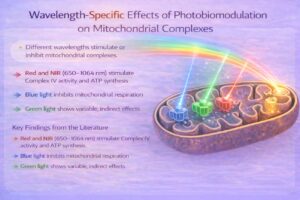
- Different wavelengths can stimulate or inhibit mitochondrial complexes.
- Both photochemical and signaling-based mechanisms are involved.
- Parameter optimization is essential for therapeutic efficacy.
Background
Mitochondrial bioenergetics play a central role in PBM mechanisms. The electron transport chain (ETC) responds differently to various wavelengths, leading to distinct effects on ATP production, redox balance, and cellular signaling.
Key Findings from the Literature
- Red and NIR light (650–1064 nm): Frequently stimulate Complex IV activity and ATP synthesis.
- Blue light: Often inhibits mitochondrial respiration under certain conditions.
- Green light: Shows variable and indirect effects on mitochondrial function.
- High vs. low power: Determines whether PBM effects are stimulatory or inhibitory.
Studies demonstrate modulation of mitochondrial complexes I–V depending on wavelength and irradiance, without significant thermal effects.
Takeaway
Photobiomodulation exerts precise and wavelength-dependent effects on mitochondrial function. Understanding these interactions is critical for designing safe and effective PBM protocols across clinical applications.
References:
Amaroli A, Pasquale C, Zekiy A, Utyuzh A, Benedicenti S, Signore A, Ravera S. Photobiomodulation and Oxidative Stress: 980 nm Diode Laser Light Regulates Mitochondrial Activity and Reactive Oxygen Species Production. Oxidative medicine and cellular longevity, 2021:6626286. doi: 10.1155/2021/6626286
Barolet AC, Villarreal AM, Jfri A, Litvinov IV, Barolet D. Low-Intensity Visible and Near-Infrared Light-Induced Cell Signaling Pathways in the Skin: A Comprehensive Review. Photobiomodulation, photomedicine, and laser surgery, 2023;41(4):147–166. doi: 10.1089/photob.2022.0127
Cardoso FDS, Barrett DW, Wade Z, Gomes da Silva S, Gonzalez-Lima F. Photobiomodulation of Cytochrome c Oxidase by Chronic Transcranial Laser in Young and Aged Brains. Front Neurosci. 2022;16:818005. doi: 10.3389/fnins.2022.818005.
Lunova M, Smolková B, Uzhytchak M, Janoušková KŽ, Jirsa M, Egorova D, et al. Light-induced modulation of the mitochondrial respiratory chain activity: possibilities and limitations. Cellular and molecular life sciences : CMLS. 2020;77(14):2815–2838. doi:10.1007/s00018-019-03321-z
Pope NJ, Denton ML. Differential effects of 808-nm light on electron transport chain enzymes in isolated mitochondria: Implications for photobiomodulation initiation. Mitochondrion. 2023;68:15-24. doi:10.1016/j.mito.2022.11.002.
O’Donnell CM, Barrett DW, O’Connor P, Gonzalez-Lima F. Prefrontal photobiomodulation produces beneficial mitochondrial and oxygenation effects in older adults with bipolar disorder. Frontiers in neuroscience, 2023;17:1268955. doi:10.3389/fnins.2023.1268955
Ravera S, Ferrando S, Agas D, et al. 1064 nm Nd:YAG laser light affects transmembrane mitochondria respiratory chain complexes. J. Biophotonics. 2019;12:e201900101. doi:10.1002/jbio.201900101
Silveira PCL, Ferreira GK, Zaccaron RP, Glaser V, Remor AP, Mendes C, et al. Effects of photobiomodulation on mitochondria of brain, muscle, and C6 astroglioma cells. Medical engineering & physics, 2019;71:108–113. doi:10.1016/j.medengphy.2019.05.008