


Highlights
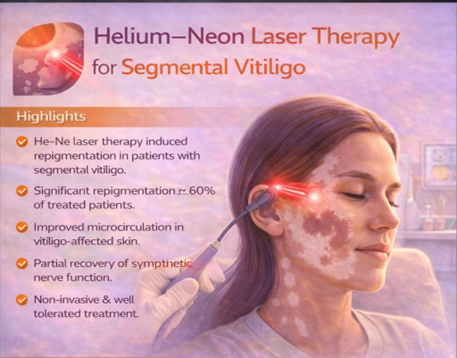
- He–Ne laser therapy induced repigmentation in patients with segmental vitiligo.
- Significant repigmentation occurred in approximately 60% of treated patients.
- Cutaneous microcirculation abnormalities improved following therapy.
- Sympathetic nerve function showed partial recovery.
- The treatment was non-invasive and well tolerated.
Background
Segmental vitiligo is associated with altered cutaneous microcirculation and sympathetic nervous system dysfunction. Therapeutic options for stable segmental vitiligo are limited, prompting interest in light-based interventions that may restore local vascular and cellular function.
Intervention Protocol
Forty patients with stable segmental vitiligo affecting the head and/or neck received He–Ne laser therapy:
- Wavelength: 632.8 nm
- Mode: Continuous wave
- Dose: 3.0 J/cm² per point
- Frequency: 1–2 sessions per week
No adjunctive treatments were used during the study.
Key Findings
- Initial repigmentation was observed after approximately 17 treatment sessions.
- About 60% of patients achieved >50% repigmentation; 7.5% achieved complete repigmentation.
- Elevated blood flow in vitiligo lesions normalized post-treatment.
- Impaired vasoconstrictive response improved, indicating partial sympathetic recovery.
Takeaway
Helium–neon laser therapy may promote repigmentation and normalize cutaneous microcirculation in segmental vitiligo. These findings support PBM as a promising non-invasive option for dermatological conditions involving vascular and neural dysfunction.
Reference: Wu CS, Hu SC, Lan CC, Chen GS, Chuo WH, Yu HS. Low-energy helium-neon laser therapy induces repigmentation and improves the abnormalities of cutaneous microcirculation in segmental-type vitiligo lesions. Kaohsiung J Med Sci. 2008 Apr;24(4):180-9. doi: 10.1016/S1607-551X(08)70115-3.