


Highlights
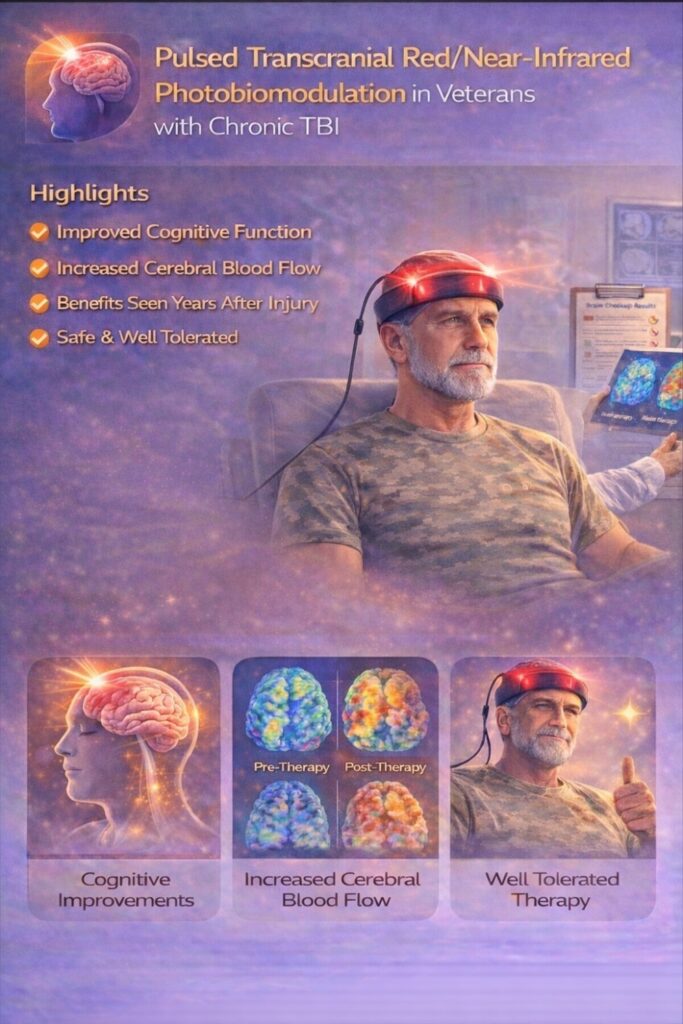
- Pulsed transcranial PBM improved cognitive performance in veterans with chronic TBI.
- Regional cerebral blood flow increased in most participants.
- Effects were observed even years after the original brain injury.
- Sequential pulsed LED stimulation was well tolerated.
- Findings support PBM as a promising neuromodulatory strategy in chronic TBI.
Background
Chronic traumatic brain injury (TBI) remains a significant clinical challenge, particularly among military veterans. Persistent cognitive deficits and reduced cerebral blood flow are common, motivating the exploration of non-invasive neuromodulation strategies such as photobiomodulation therapy (PBMT).
Intervention Protocol
This case series evaluated 12 military veterans with chronic TBI (>18 months post-injury) treated with pulsed transcranial PBMT using LED arrays:
- Light source: Red and near-infrared LEDs
- Pulse frequencies: 73, 587, and 1175 Hz
- Duty cycle: 35%
- Session duration: 20 minutes
- Frequency: 3 sessions per week for 6 weeks
- Total sessions: 18
Two neoprene therapy pads containing red and infrared LEDs were placed over the cranium.
Key Findings
- Cognitive improvements were observed in 40% of neuropsychological subscales.
- Increased regional cerebral blood flow was detected in 66.7% of participants using SPECT imaging.
- Quantitative analysis confirmed significant rCBF increases in responsive individuals.
- No serious adverse events were reported.
Takeaway
Pulsed transcranial PBM using red and near-infrared LEDs may enhance cerebral blood flow and cognitive function in individuals with chronic TBI. These findings support further controlled studies and the integration of quantitative biomarkers in PBM research.
Reference: Hipskind SG, Grover FL Jr, Fort TR, Helffenstein D, Burke TJ, Quint SA, Bussiere G, Stone M, Hurtado T. Pulsed Transcranial Red/Near-Infrared Light Therapy Using Light-Emitting Diodes Improves Cerebral Blood Flow and Cognitive Function in Veterans with Chronic Traumatic Brain Injury: A Case Series. Photobiomodul Photomed Laser Surg. 2019; 37(2):77-84. doi: 10.1089/photob.2018.4489