


Highlights:
- Better mood support in 4 weeks: Adding vibroacoustic therapy to standard care was linked to greater improvements in depressive symptom scores compared with standard care alone.
- Emotional balance boost: Participants reported more positive emotions and fewer negative emotions after the vibroacoustic program.
- Less stress, calmer nervous system signals: The therapy group showed lower perceived stress and improved HRV markers (e.g., SDNN, RMSSD), suggesting better autonomic regulation.
- Well tolerated: Sessions were supervised and comfortable, with no adverse events reported.
Depression is one of the most common mental health challenges worldwide, and while medication and psychotherapy remain the standard approaches, there is growing interest in non-pharmacological interventions that can complement traditional care. One such approach is vibroacoustic therapy, also known as somatosensory music therapy, which combines sound and vibration to promote relaxation and emotional balance.
A recent study published in the International Journal of Mental Health Promotion explored how this therapy can support patients with depression, both emotionally and physiologically.
Study Overview
The study included 66 patients with depression, randomly divided into two groups:
- Control group → received standard psychiatric treatment and nursing care.
- Intervention group → received the same standard care plus vibroacoustic therapy.
The therapy consisted of 30-minute sessions, three times per week, for 4 weeks. During these sessions, patients were exposed to a carefully controlled combination of music and vibration delivered in a safe and supervised environment.
Precautions ensured patient safety and comfort, including avoiding stimulants before sessions, keeping sound levels between 40–60 dB, and real-time adjustments of music and vibration based on individual responses. A therapist was present at all times, and patients were gently awakened after each session.
Key Findings
After 4 weeks, patients in the vibroacoustic therapy group showed significant improvements compared to the control group, including:
- Reduced depressive symptoms (as measured by HAMD scores).
- Increased positive emotions and 😊 reduced negative emotions.
- Lower levels of perceived stress (CPSS scores).
- Improved autonomic regulation, with higher heart rate variability (HRV) indices such as SDNN and RMSSD.
Notably, the therapy was well tolerated, with no adverse events reported.
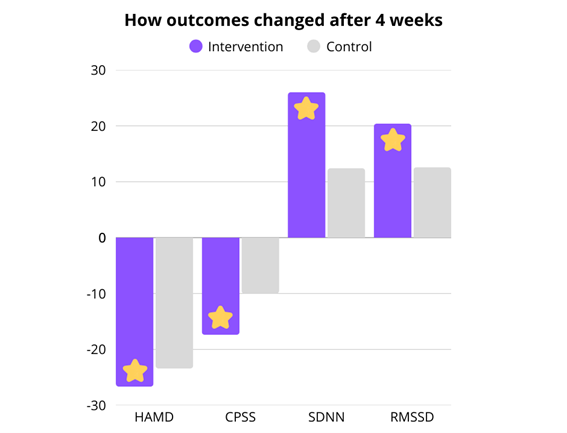
Figure 1. How outcomes changed after 4 weeks. After 4 weeks, the intervention group showed bigger drops in HAMD and CPSS (meaning fewer depression symptoms and less perceived stress) and bigger increases in SDNN and RMSSD (meaning higher HRV, a sign of improved nervous system “rest & recovery” balance). Stars highlight outcomes where the intervention improved more than control.
Why It Matters
The results suggest that vibroacoustic therapy can be an effective adjunct to standard depression treatment, offering multiple benefits:
- Lower depressive symptom scores (HAMD)
- More positive emotions and fewer negative emotions
- Lower perceived stress (CPSS)
- Improved autonomic regulation, reflected by higher HRV measures (e.g., SDNN, RMSSD)
By combining sound and vibration in a structured way, this therapy offers a safe, non-invasive, and holistic approach that may be valuable not only in clinical settings but also in family and community rehabilitation contexts.
Conclusion
This study highlights the potential of vibroacoustic therapy as a supportive tool for people living with depression. By promoting emotional balance, reducing stress, and enhancing physiological regulation, it represents a promising non-pharmacological pathway that could complement traditional treatments and improve overall wellbeing
Reference: Wang X, Xie Z, Du G. Research on the Intervention Effect of Vibroacoustic Therapy in the Treatment of Patients with Depression. The international journal of mental health promotion. 2024 Jan 1;26(2):149–60. doi: 10.32604/ijmhp.2023.030755
Link to full paper: Read here