


Highlights:
- Better joint attention after VAT: Children who received vibroacoustic therapy showed measurable gains in a core attention skill closely tied to social interaction.
- Calmer, happier sessions: Many children described the experience as soothing and enjoyable — important signals for real-world use.
- Noticed in the classroom: Teachers reported greater engagement and attention after sessions.
- School-friendly and well tolerated: The study supports VAT as a feasible, non-invasive option that can fit into everyday settings.
Helping autistic children feel calmer and stay engaged can make a real difference in learning, relationships, and daily life. Vibroacoustic therapy (VAT) — a gentle approach that combines music with low-frequency sound vibrations — is gaining attention as a non-invasive way to support emotional regulation and attention.
A 2025 pilot study explored whether VAT could help improve these areas in autistic children within a real-world school environment.
What Was the Study Like?
The study included 18 autistic children (ages 9–12) who were identified by a school psychologist as having attention difficulties. Children were placed into:
- a VAT group (n=9), and
- a control group (n=9).
The VAT group completed 10 sessions over six weeks at a public primary school in Pretoria, South Africa.
Researchers looked at attention changes over time (baseline, mid-treatment, post-treatment, and one week later). They also gathered qualitative feedback through observations and child-friendly interviews so children could share how the sessions felt.
What Did They Find?
The most notable outcome was a statistically significant improvement in joint attention in the VAT group. Joint attention is the ability to share focus with someone else — for example, looking at something together or following another person’s gaze — which plays a key role in social communication and learning.
Just as importantly, the qualitative feedback added a human layer to the data:
- Children often described the sessions as calming and enjoyable.
- Teachers reported noticing greater engagement and attention in class after sessions.
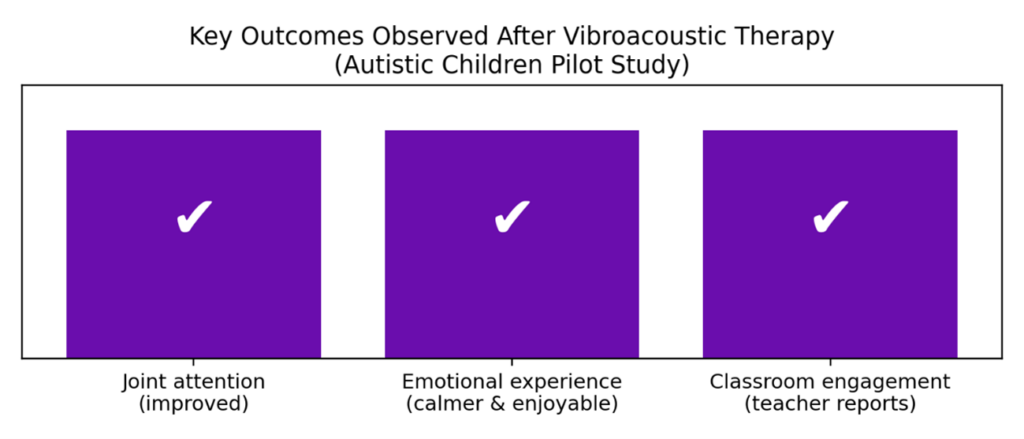
Figure 1. Key Outcomes Observed After Vibroacoustic Therapy in Autistic Children. This figure summarizes the main outcomes reported in a pilot study of vibroacoustic therapy in autistic children. Improvements were observed in joint attention, emotional experience (calmness and enjoyment), and classroom engagement, based on quantitative assessment and qualitative reports from children and teachers.
Why This Matters
This early research suggests that vibroacoustic therapy may offer more than relaxation — it may support attention skills that are meaningful in everyday life, especially in social and learning contexts. The authors also emphasized that VAT appeared feasible and well tolerated, which matters for any approach intended for regular use.
Because this was a small pilot study, larger and more controlled studies are still needed. But the early signals are encouraging and point to VAT as a sensory-based, school-compatible option that could complement existing support strategies.
Reference: Moore J, Farquharson K, Lotter C. “Grooving in My Body”: A Mixed-Methods Pilot Study of Vibroacoustic Therapy’s Effects on Emotion Regulation and Attention in Autistic Children. Healthcare (Basel). 2025;13(5):465. Published 2025 Feb 21. doi:10.3390/healthcare13050465
Link to full paper: Read here