


Highlights:
- Music doesn’t just relax — it activates. After exercise, listening to music further increased nervous system “alert mode,” showing that sound can actively shape how the body responds post-workout.
- Timing matters. Music played after exercise amplified autonomic activation, suggesting sound can influence recovery and engagement depending on when it’s used.
- Your body’s baseline makes a difference. People with higher sympathetic activity to begin with showed stronger physiological responses, highlighting the personalized nature of music-based interventions.
- Feeling the music may enhance the effect. Listening through a body sonic chair — where music is both heard and felt — may deepen the nervous system response by engaging multiple senses.
Can music change what happens inside your body after a workout? A study by Urakawa and Yokoyama (2005) suggests it can.
Researchers tracked heart rate variability (HRV) — a common, non-invasive way to observe how the autonomic nervous system shifts between “go mode” (sympathetic activation) and “recovery mode” (parasympathetic activity) — before and after exercise, with and without music.
What the study found (in simple terms)
- Exercise shifted the body into “go mode.” After exercise, HRV patterns reflected higher sympathetic activation, which is a normal response to physical stress.
- Music added an extra boost in activation after exercise. When participants listened to music post-exercise, markers of sympathetic activity increased further, showing that music can be stimulating — not just soothing — depending on timing and context.
- Your baseline matters. People who started with higher sympathetic tone tended to show a stronger post-exercise sympathetic response overall.
- Preference may influence the response. Participants listened to music they personally enjoyed (pop, jazz, classical, healing music, nature sounds), and the study suggests personally preferred music may interact more strongly with the body’s post-exercise state.
- Mind and body move together. Mood and subjective experience may contribute to physiological responses, reinforcing the link between psychology and autonomic regulation.
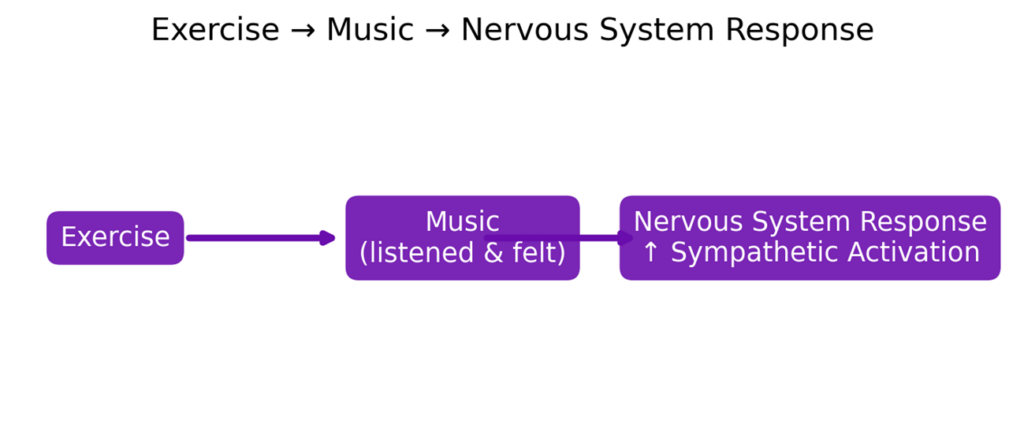
Figure 1. How Sound Can Shape Post-Exercise Autonomic Activity. This figure summarizes findings from Urakawa and Yokoyama (2005), showing that music after exercise can further influence the autonomic nervous system, reflected by HRV markers of sympathetic activation. In the post-exercise window, sympathetic activity is often a normal, functional response that supports circulation, alertness, and recovery processes.
Inside the music experience
This wasn’t just “background music.” Participants listened in a controlled, comfortable environment:
- A soundproof room at 22°C
- A body sonic chair with built-in speakers and low-frequency transducers
- The music could be both heard and felt, creating a vibroacoustic-style sensory experience
Takeaway
This study highlights an interesting idea: music can actively shape autonomic activation after exercise, especially when it’s music you enjoy and when it’s delivered as a full sensory experience. In other words, music isn’t only about relaxation — it can also be a tool for engagement and nervous-system modulation during the post-exercise window.
Reference: Urakawa K, Yokoyama K. Music can enhance exercise-induced sympathetic dominancy assessed by heart rate variability. Tohoku J Exp Med. 2005;206(3):213-218. doi:10.1620/tjem.206.213
Link to full paper: Read here