


Highlights:
- A comfort boost early in rehab: Patients who added LBV reported less pain and fewer symptoms at 4 and 8 weeks.
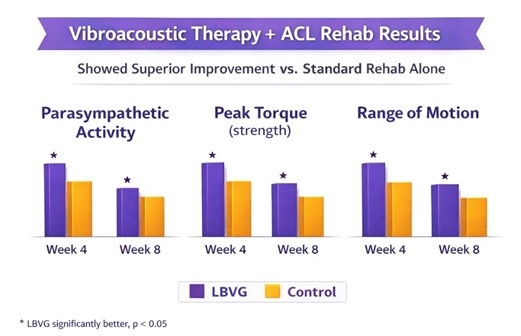
- Better mobility + strength markers: The LBV group showed meaningful gains in range of motion and muscle performance during recovery.
- Supports the “recovery state”: Autonomic measures shifted toward lower stress physiology and greater parasympathetic activity in the LBV group.
- A practical add-on to standard rehab: LBV is non-invasive, session-based, and designed to complement — not replace — traditional physical therapy.
Recovering from an anterior cruciate ligament (ACL) reconstruction can be a long process — often involving pain, stiffness, and the gradual rebuilding of strength. Researchers are increasingly exploring whether adding supportive tools to standard rehabilitation can help patients feel better and progress more efficiently.
One approach getting attention is local vibroacoustic therapy (LBV) — a combination of targeted vibration and sound-based stimulation applied to the body. In a randomized study published in Medicina (2019), Park and colleagues investigated whether adding LBV to a traditional rehab program could improve recovery-related outcomes after ACL reconstruction.
Study Design: Rehab With vs. Without LBV
A total of 24 post-ACL reconstruction patients were randomized into two groups:
- LBV + rehab group: standard rehabilitation plus local vibroacoustic therapy
- Rehab-only group: the same rehabilitation program without LBV
In the LBV group, therapy was delivered using the Evocell device, with 30-minute sessions at a set intensity level. (A menthol-based gel was used to reduce friction and improve comfort during application.)
What the Study Found
✅ Less pain and fewer symptoms
The LBV group reported lower pain and symptom scores at both 4 and 8 weeks compared with the rehab-only group — suggesting LBV may help people feel more comfortable earlier in the process.
✅ Stronger recovery markers for flexibility and strength
Only the LBV group showed statistically significant improvements in:
- Range of motion (ROM)
- Muscle performance, including increases in extensor and flexor peak torque
These gains were not observed to the same extent in the rehab-only group.
✅ Healthier autonomic balance (stress physiology)
Measures related to autonomic nervous system activity shifted in a favorable direction in the LBV group by week 4, including lower sympathetic activity and higher parasympathetic activity compared with the rehab-only group. In practical terms, this pattern can reflect a more “recovery-supportive” physiological state.
✅ Psychological trends
Anxiety decreased over time in both groups, but the LBV group showed a stronger overall pattern of improvement in pain perception and symptom experience, potentially reflecting the calming sensory component of vibroacoustic input.
How Might Vibroacoustic Therapy Help?
Vibroacoustic therapy combines mechanical vibration with a sound component, creating gentle sensory stimulation that may support recovery by helping the body and nervous system shift into a more relaxed, recovery-oriented state. Researchers have proposed that these inputs may be linked to changes in comfort, movement readiness, and stress physiology — factors that matter during rehab.
Final Takeaway
This study adds to growing interest in vibroacoustic stimulation as a non-invasive, supportive add-on to traditional ACL rehabilitation. The early findings are encouraging: less pain, improved ROM, stronger muscle performance markers, and more balanced autonomic activity in the group that used LBV.
As rehabilitation continues to evolve, vibroacoustic therapy may become a valuable tool for clinics looking to enhance the recovery experience — helping patients feel better while rebuilding strength and mobility.
Reference: Park JM, Park S, Jee YS. Rehabilitation Program Combined with Local Vibroacoustics Improves Psychophysiological Conditions in Patients with ACL Reconstruction. Medicina (Kaunas). 2019;55(10):659. Published 2019 Sep 30. doi:10.3390/medicina55100659
Link to full paper: Read here